
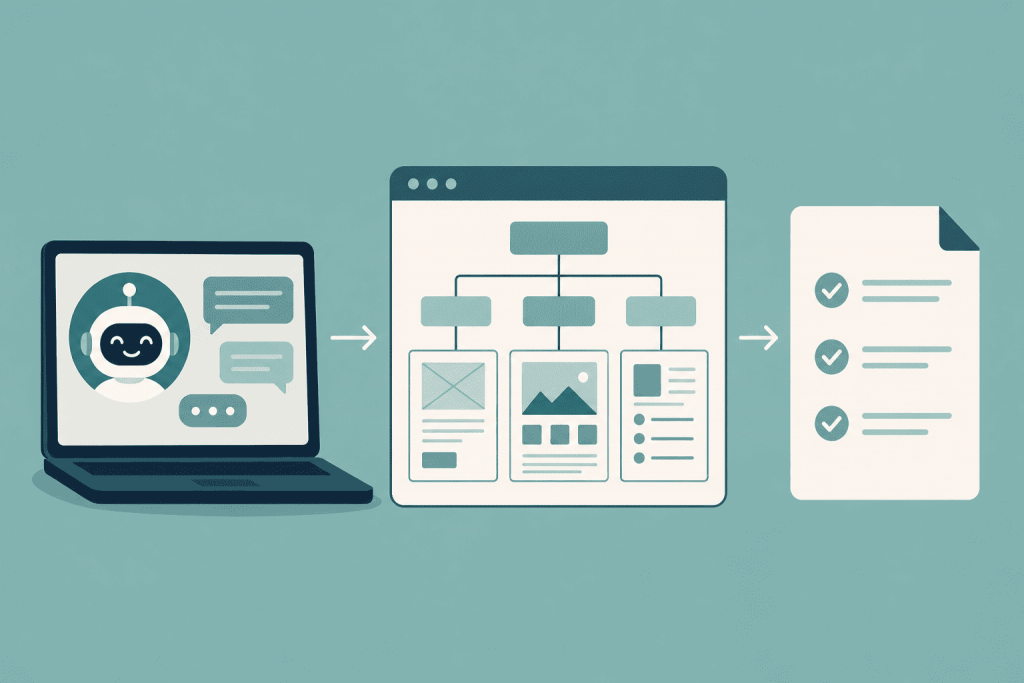
When a new website idea comes up and finding a contractor is urgent, spending weeks on design and gathering requirements feels like unnecessary bureaucracy. The easiest way is to open ChatGPT, throw in a couple of paragraphs, and ask it to “write a PRD/spec.” Within a few minutes, a neat document appears with structure, roles, and integrations, looking entirely solid. However, a pretty wrapper does not guarantee that the developers will understand the task without distortions, as AI only structures known templates but cannot test real business logic for resilience.
This is exactly why it is crucial to separate: when AI will actually make life easier and save budget, and when without classic business analysis a project risks getting stuck in an endless loop of reworks.
When a spec can be written with ChatGPT
ChatGPT is a super tool for standard, predictable solutions. For instance, when launching a simple landing page, a business card site, a basic corporate website, a blog, or a catalog without complex personal accounts. That is, when it is clearly known in advance: what pages are needed, what the user types into a form, and where this submission lands.
In this case, the neural network helps pull thoughts out of one’s head and clean them up. Everything can be dumped there: company description, target audience, references, requirements for language versions, or mobile adaptation. The AI will stitch it into a cohesive draft specification that is good enough to present to a designer or developer.
Practical tip: instead of prompting “write a professional spec,” it is better to instruct ChatGPT to ask clarifying questions about the project first. Let the AI generate a list of 10-15 points. This immediately reveals forgotten pages and contradictory requirements that were previously overlooked.
What ChatGPT actually creates
Let’s be realistic: the output is not a finished spec, but a detailed brief or a draft of requirements. The neural network will describe a catalog or payment gateway integration, but a significant portion of the details will be either made up or taken from generic internet templates.
For example, the phrase in a spec “user receives a notification after ordering” seems perfectly clear. But for a developer, it is not enough. What kind of notification? SMS, email, a message in a Telegram bot? How many seconds after should it go out? What happens if the payment hangs, but the item is already reserved? This level of detail is usually where budgets get wasted, because the client expected one thing, and the programmer built another.
ChatGPT will not answer these questions unless the source data already contained those rules. It might propose a logical option, but it will only be a hypothesis. Therefore, it is best to explicitly ask the AI to clearly mark in the text: which requirements are confirmed, and which are its own suggestions and “hallucinations.”
When a business analyst is needed
A business analyst (BA) is not there to write pretty sentences. Their job is to get under the hood of the business and figure out how everything actually works, who the end user is, what their motivation is, and what happens when things do not follow the happy path.
This is critical for complex products: marketplaces, booking services, CRM systems, internal ERPs, or e-commerce sites with dynamic pricing and multiple integrations. A phrasing like “the site must sync with 1C/ERP” will not cut it here. It is necessary to clearly specify: what exact data is transferred, how frequently, who has priority during data conflicts, and how the system reacts if the sync server suddenly goes down.
An analyst conducts interviews, extracts hidden requirements, maps out process flows, finds contradictions before coding even starts, and helps trim down excess features (MVP) so that budget is not wasted on things no one will use.
Can ChatGPT replace a business analyst?
Fully – no, but it can become a great assistant for one. AI takes over the routine: preparing a list of questions for a meeting, structuring chaotic post-discussion notes, translating requirements into User Stories, or quickly drafting a spec outline.
AI is also excellent at spotting “fluff” in text. If a finished spec is fed to it, one can ask to highlight vague phrases. All those “user-friendly interface,” “fast loading,” and “secure authentication” descriptions are a developer’s nightmare because they cannot be measured during project handoff. ChatGPT easily pinpoints such areas, though turning them into specific metrics and requirements still requires collaboration with the tech team.
In other words, AI saves time at the start and handles the formatting, but responsibility for architectural decisions remains with humans.
Who else should see the spec before kickoff
Even if an analyst has worked on the document, it is useful to run it past other roles:
- The designer evaluates whether the user flows fit logically into the interface and if the structure is overloaded.
- The tech lead or senior developer checks the feasibility of features. Perhaps a certain “nice-to-have” triples the development cost, and it is simpler to replace it with an out-of-the-box service.
- The SEO specialist must input requirements for URL structure, tags, and redirects before the first lines of code are written. Otherwise, database structures will have to be reworked after release.
- If the project is deployed on a VPS or dedicated server, a DevOps engineer or sysadmin should be involved. They need to understand load requirements in advance to set up backups, monitoring, and deployment pipelines.
How to know which approach is needed
The guiding metric is not the size of the website, but the number of exceptions to the rules and integrations.
If the logic is linear (enter – choose – leave contacts), making a draft with ChatGPT and discussing it with developers is more than enough for a start.
If branching logic begins (one customer gets a 5% discount, another gets 10%, there is integration with three delivery services, and an order must automatically trigger a task in a CRM), it is better to bring in a business analyst before the final development estimate is voiced.
The most practical compromise is to gather the initial vision and basic requirements via ChatGPT, and leave all complex nodes, custom accounts, and integration logic to a specialist. This saves time and prevents ending up with a product that, upon release, works entirely differently than planned.