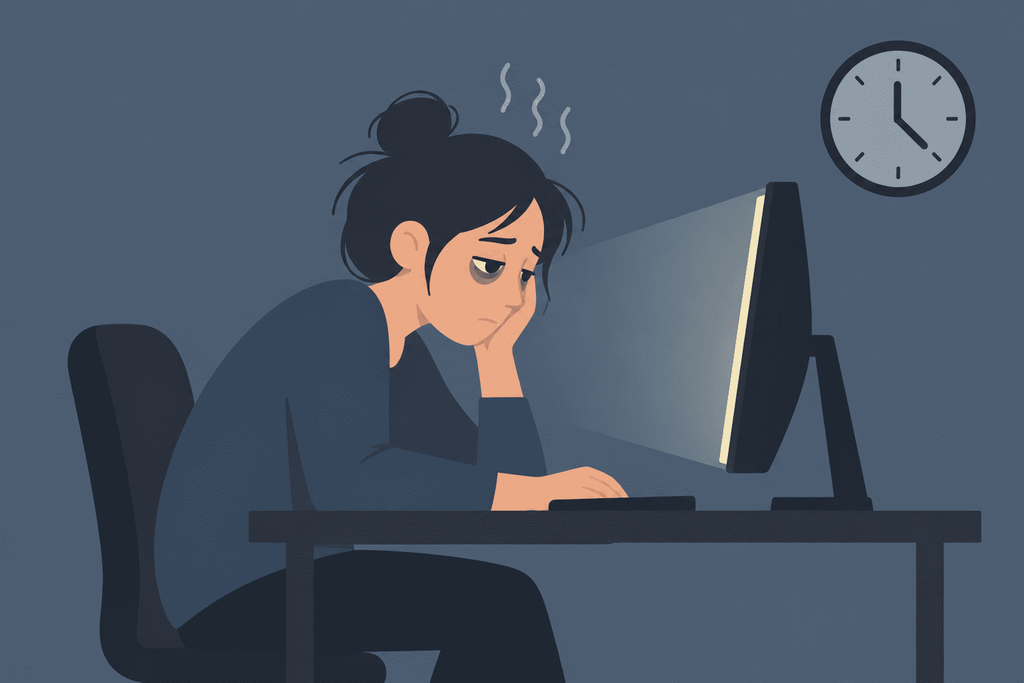
That familiar feeling when the workday seems to be over, but your head feels heavy, your eyes burn, and even after a normal night’s sleep there is still no energy? Physically, it seems like you have not really been working – the whole day was spent in a comfortable chair in front of a monitor, yet by evening you feel completely drained. Most people put it down to overwork or a lack of vitamins, but the real reason lies in how our body reacts to sitting in front of a screen every day.
How Blue Light Disrupts Natural Biorhythms
The main factor that quietly drains our energy is the backlighting of monitors, smartphones, and tablets. Displays emit intense light in the blue spectrum. In nature, such bright light appears only during the day, when the sun is at its highest, so for the brain this is a direct signal: it is time to work.
When you keep looking at a screen for hours without a break, the brain assumes it is still the middle of the day outside and blocks the production of melatonin – the hormone responsible for relaxation and preparation for sleep. Even if you manage to fall asleep immediately after turning off the computer, the sleep remains shallow. The nervous system simply does not have enough time to recover, and the next morning the fatigue has not gone anywhere. It only keeps accumulating.
Eye Muscle Strain
In real life, our eyes constantly change focus, but at a computer everything is different. For hours, the eyes remain fixed on a flat surface about half a meter away. To keep that image sharp, the focusing muscle of the eye has to stay tense all the time. It is like holding a light dumbbell at arm’s length: for the first few minutes it feels easy, but after eight hours your arm would simply give out.
There is another factor as well. Normally, a person blinks around twenty times a minute – this refreshes the tear film. When we stare at text or code, the blinking rate drops three to four times. The eyes dry out, a gritty and burning sensation appears, and the brain spends additional resources just coping with this constant discomfort.
Screen Flicker and Sensory Overload
The image on a monitor is not a static page in a book. It is made up of thousands of pixels that are constantly refreshing, and it is also illuminated from within. Even if we do not notice this flicker, the eyes and brain still register it and continuously readjust focus.
At the same time, small distractions are constantly pulling our attention away: chat notifications, new emails, pop-up windows, dozens of open tabs. The brain simply is not designed for such a chaotic flow of information. Every time attention jumps to a new stimulus, part of the nervous system’s resources is used up. By the end of the day, that reserve is depleted, leaving the familiar feeling of “fog” in the head.
Stagnation Caused by a Static Posture
When we sit in the same position in front of a monitor for hours, it is not only the eyes that suffer, but the entire circulatory system as well. The back is bent, the shoulders are lowered, the neck is stretched forward – in this position, the blood vessels supplying the brain are compressed.
Because of the lack of oxygen and nutrients, the brain begins to “slow down.” The body responds with sluggishness, drowsiness, and loss of concentration. And constant tension in the neck and shoulders often turns into a dull headache by evening.
How to Give the Body Real Rest
Giving up computer work completely is impossible, but making screen time less exhausting is entirely realistic.
The simplest thing is to introduce a basic rule of visual hygiene. Try at least two or three times an hour to look away from the monitor and spend about twenty seconds looking somewhere into the distance – out the window or down the hallway. This allows the eye muscles to relax and helps relieve the spasm.
It is also worth adjusting the lighting. A couple of hours before the end of the workday, turn on eye protection mode or a blue light filter on your devices so the brain can start adjusting to the evening. And do not sit in front of a bright monitor in complete darkness: the sharp contrast tires the eyes several times faster.
And most importantly – add movement. Getting out of your chair briefly every hour and doing a simple stretch for the neck and shoulders helps restore normal blood flow. And if in the evening you put your phone aside at least an hour before bed and spend some time without screens, the nervous system will finally be able to properly reset.
Preserve Your Resources and Take Care of Security
Just as the body needs regular breaks, quality sleep, and time to recover in order to function normally, any digital infrastructure needs its own protection against failures. You can follow visual hygiene rules, set up perfect lighting, and put your phone away in the evening, but if something suddenly goes wrong on the server, the stress will return instantly and undo all that rest.
The best way to protect your own nerves and ensure a peaceful night’s sleep is to take care of your projects’ security in advance. Configured automatic VPS backups work in much the same way as proper evening rest: they ensure that all data remains safe, and that any situation can be fixed easily in just a few clicks, without spending your own health and resources on it.