
Tag: Data storage

Why We Save Hundreds of Things We Never Return To

A man stands near a large folder with files, documents, and images that are kept just in case.
Not everything saved is really needed.

There are several tabs open in the browser, a “read later” folder in Telegram, saved posts piling up on social media, and screenshots in the gallery whose meaning is already hard to remember. Each of these things once seemed useful. An article might have come in handy for work, a video looked worth watching in the evening, and a list of services felt too valuable to lose. A few weeks pass, and no one returns to most of them. Still, we keep saving more.

China Launches Giant Computer Spanning 2000 km

Three people are working with laptops, one of them is pressing a button on the screen, symbolizing the launch of a supercomputer.
Chinese project that connects over 2,000 km of data centers into a single network

In the world of information technology, China continues to amaze with its new ambitious projects. One of the latest achievements is the launch of the Future Network Test Facility (FNTF), a distributed network of data centers stretching over 2000 kilometers. This is not just another data center — it’s a whole system that unites dozens of data processing centers, creating a so-called “giant computer.” The goal of this project is to provide massive computing power for the development of artificial intelligence, telemedicine, and the industrial internet. In this article, we will explore how this project will change the landscape of computing power and why it is significant for the technologies of the future.

How Toshiba Takes HDD Technology to a New Level

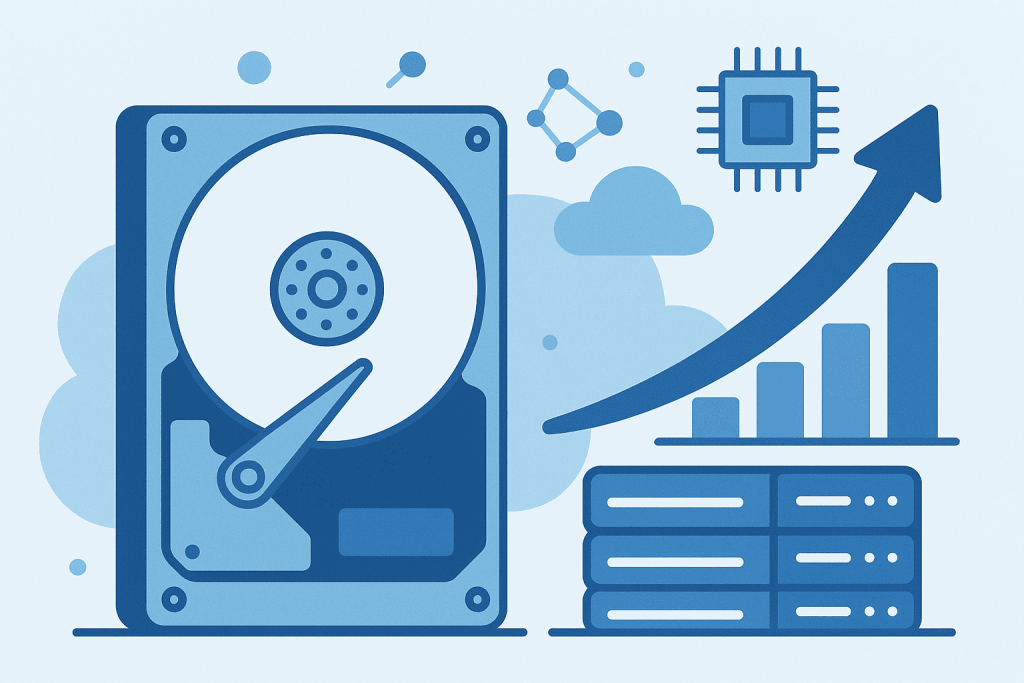
Image of hard drive, servers and performance growth graph.
Evolution of HDD technologies and increasing the efficiency of server solutions

While the world is rapidly shifting toward solid-state drives (SSD), Toshiba has proven that traditional hard drives (HDD) are far from obsolete. In autumn 2025, the company announced a major breakthrough — the creation of a technology that allows 12 magnetic platters to fit inside a standard 3.5-inch drive casing. This enables capacities of up to 40 terabytes (TB) per drive — a record for its class.

-->