
Artificial intelligence has become a familiar tool for business and everyday life in recent years. Chatbots, text generation, recommendation systems, and analytics are no longer perceived as experimental technologies. At the same time, the concept of agentic artificial intelligence is increasingly appearing in professional discussions. It is often presented as the next stage in AI development, yet skepticism around this technology is also growing. Gartner analysts predict that more than 40% of agentic AI projects will be canceled by the end of 2027, indicating a serious gap between expectations and reality.
How Traditional Artificial Intelligence Works
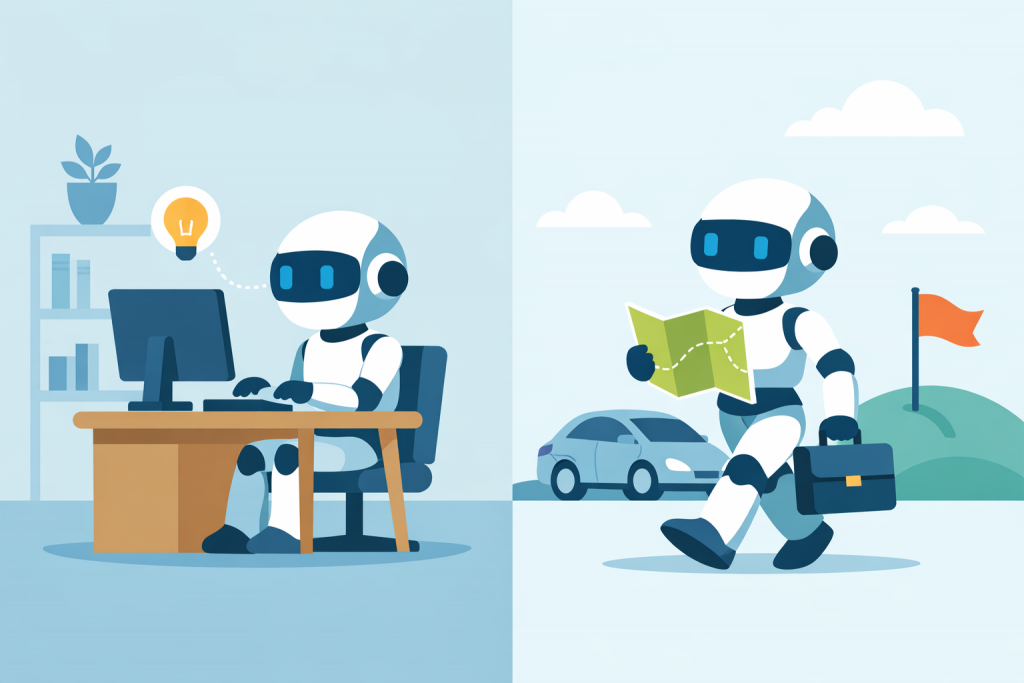
In the classical sense, artificial intelligence operates according to a reactive model. It receives a specific request and performs a single action in response. This may include text generation, image analysis, answering a question, or searching for information. Such systems do not have their own goals and do not control processes over time. Each interaction is usually a separate event, even if a limited context is used.
For this reason, traditional AI is well suited to individual tasks and scales easily as cloud-based services. It does not require a constant presence within the user’s infrastructure and often follows a simple “request–response” principle without deep integration into internal systems.
What Is Agentic Artificial Intelligence
Agentic artificial intelligence operates on a different principle. Instead of executing a single instruction, it is given a goal and independently plans how to achieve it. Such a system can perform multiple actions in sequence, interact with various services, evaluate outcomes, and adjust its behavior during execution.
In effect, agentic AI becomes an autonomous participant in the digital environment. It does not merely respond to requests but acts within predefined rules and constraints. This autonomy is what fundamentally distinguishes the agentic approach from traditional AI solutions.
What Is the Key Difference Between Agentic and Traditional AI
The main difference lies in the level of responsibility the system has for the outcome. Traditional AI performs an action, whereas agentic AI strives to achieve a result. This involves dealing with uncertainty, making decisions across multiple steps, and interacting with real business processes.
As a result, agentic AI is significantly more complex to implement. It requires not only high-quality models but also clearly defined security policies, risk control mechanisms, and continuous monitoring. According to Gartner, most such projects are currently at the experimental or proof-of-concept stage and are often driven more by hype than by genuine business needs.
Why Agentic AI Is Closely Linked to Servers and Data Centers
Unlike traditional AI services, agentic artificial intelligence typically operates continuously. It retains state, context, and the results of previous actions while interacting with a company’s internal systems. This makes it directly dependent on server infrastructure and data centers.
Agentic AI integrates with CRM and ERP systems, billing platforms, internal databases, and analytics tools. Such integrations require stable servers, secure communication channels, and predictable workloads. In addition, the parallel operation of multiple agents and long chains of actions create increased demands for computing resources and scalability.
Underestimating this infrastructure complexity is often the reason agentic AI projects fail. Gartner explicitly notes that rising costs and the difficulty of integrating with existing systems are key factors behind the cancellation of such initiatives.
Hype and the Problem of “Agent Washing”
Additional confusion is caused by a phenomenon Gartner refers to as “agent washing.” Many vendors rename existing products—such as chatbots, AI assistants, or robotic process automation systems—as “agentic” without adding real autonomy. According to analysts, out of thousands of agentic AI vendors, only around 130 offer truly agentic solutions.
This creates inflated expectations and leads to disappointment when projects fail to deliver the expected return on investment. Most current models still lack the maturity required to autonomously achieve complex business goals or to correctly handle nuanced, time-dependent instructions.
Does Agentic AI Have a Future
Despite critical assessments, Gartner does not deny the potential of agentic artificial intelligence. Forecasts suggest that by 2028, at least 15% of everyday work decisions will be made autonomously using agentic AI, and one third of enterprise software products will include agentic capabilities.
The key recommendation from analysts is to implement agentic AI only where it provides clear business value or a measurable return on investment. In many cases, success is possible only if processes are rethought from the ground up rather than attempting to attach agents to outdated systems.
Conclusion
Agentic artificial intelligence is not simply an improved version of traditional AI. It represents a different approach that involves autonomy, goal-oriented behavior, and deep integration with business infrastructure. This is why it is closely tied to servers and data centers and requires mature technological solutions.
Disappointment surrounding agentic AI does not mean its failure. Rather, it signals that the technology is entering a phase of realistic evaluation. Where expectations align with actual capabilities and there is a willingness to invest in infrastructure, agentic AI can become an important element of digital business development.