
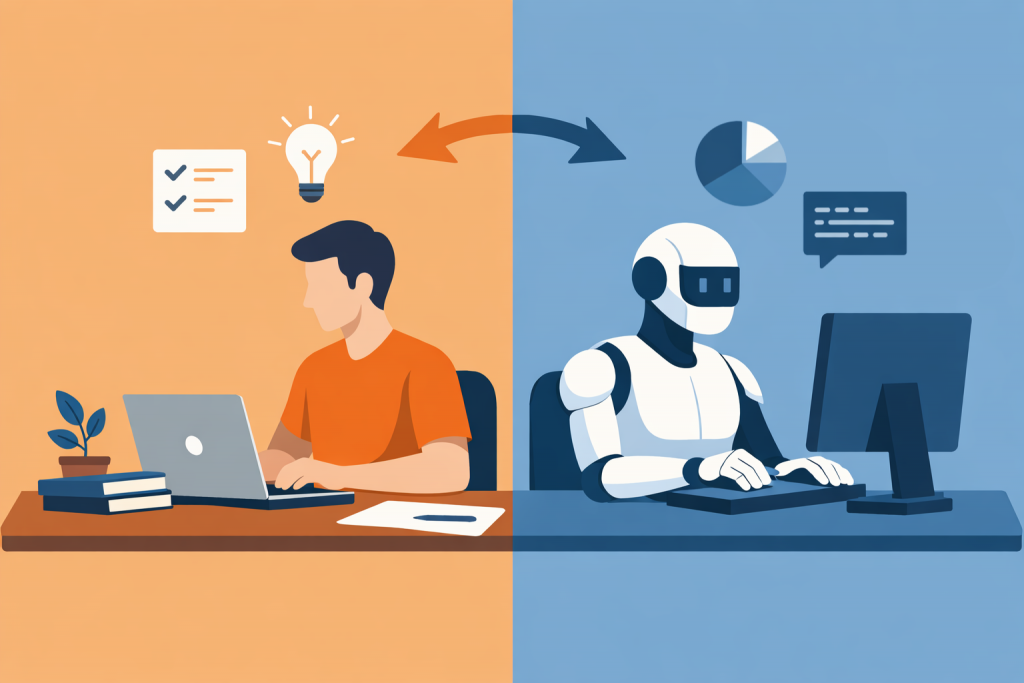
Today discussions about artificial intelligence are gradually moving out of the “will it replace or will it not” debate into the sphere of practical task management. In practice we are not seeing mass disappearance of professions, but a redistribution of roles. AI becomes another tool in the stack, to which the technical part is delegated, while architectural oversight and responsibility for the final release remain with a human.
The boundary between routine and expertise
Any work process is a mix of contextual decisions and mechanical execution. AI fits the mechanical part perfectly: processing large data sets, writing template code, or formatting reports according to predefined rules. At the same time, an algorithm does not see business risks, does not feel ethical nuances, and does not understand the long-term goals of a company. That is why we talk about delegating functions rather than about an autonomous system doing the work on its own.
Spotify case: development inside a messenger
An interesting example of process transformation was demonstrated at Spotify. There, senior engineers spend less and less time physically sitting at the keyboard in the traditional sense. The work cycle may start in Slack on the way to the office: a developer assigns an AI agent a task to fix a bug or add a minor feature to an iOS application.
By the time the specialist reaches the workplace, the system may already be building the build and sending it for review. The key value here is not in the lines of code written, but in the engineer’s ability to verify the result, evaluate the logic of the changes, and integrate them into the product. Product delivery speed grows several times over, yet control remains in the hands of the person who understands the architecture of the system.
The new role of the specialist
When technical execution goes “outsourced” to neural networks, the specialist’s focus shifts. It is no longer enough to simply know the tools – one must be able to formulate tasks correctly and critically evaluate the output. Responsibility, meanwhile, only increases. Any mistake produced by an algorithm and overlooked by a human automatically becomes the specialist’s mistake.
Why control cannot be automated
AI operates with probabilities and patterns, but it lacks an understanding of reality. It can generate a legally correct text that at the same time is completely harmful to the reputation of a specific brand. Without human verification, delegation turns into an uncontrolled process that produces errors in geometric progression. Success now depends on how well this “human-machine” filter is configured.
Transformation of skills
A new demand is forming on the labor market: those who can work with AI as a partner are gaining an advantage. The technical base remains the foundation, but on top of it appear new abilities – formulating prompts, analyzing anomalies in algorithm behavior, and thinking strategically. This is a transition from the “executor” model to the “process controller” model.
In the end, partial delegation becomes the norm. This is not a temporary hype but a logical stage of optimization. For companies building such a model, infrastructure reliability becomes critical. For AI tools and automation to operate without failures in real time, stable server solutions are required. Providers like Server.UA supply exactly the technical foundation on which specialists can deploy modern workflows without worrying about system availability.
Leave a Reply
You must be logged in to post a comment.