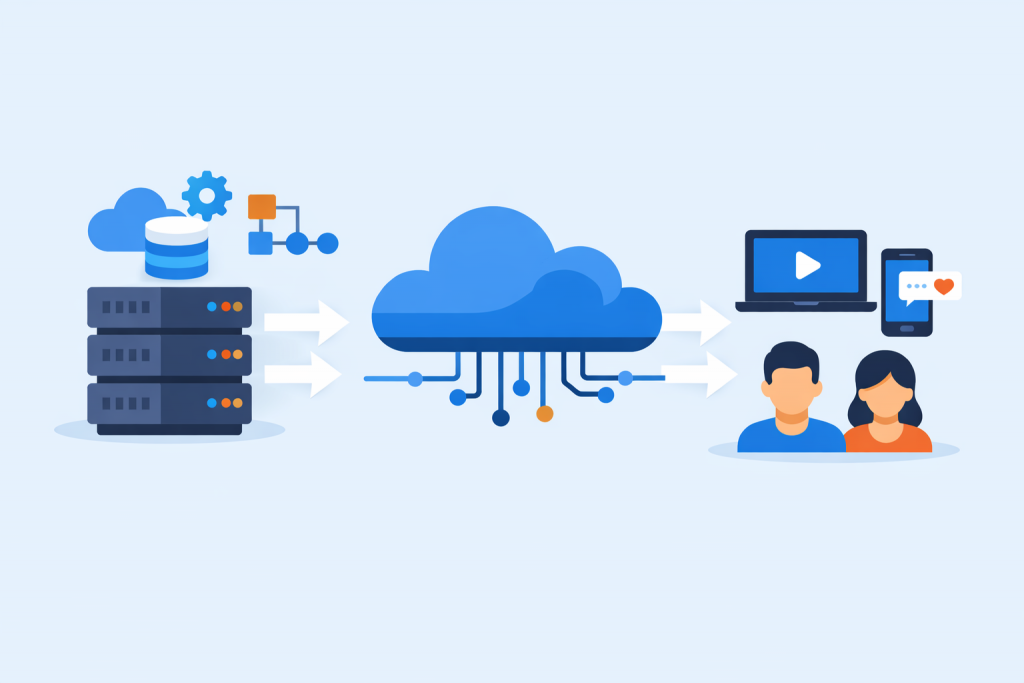
When a website opens instantly and a banking app doesn’t “freeze” during a transaction, users tend to take it for granted. Yet behind every request there is a rack in a data center, filled with servers, switches, and storage systems. What happens inside these sealed rooms – from chip shortages to shifts in logistics chains – inevitably rolls down to the end user. The only question is how quickly infrastructure costs for providers turn into subscription prices or affect the speed of a service.
Why the AI hype is draining resources from the market
In recent years the server segment has been operating almost in a storm mode. The massive deployment of neural networks requires resources that exceed the needs of traditional hosting by orders of magnitude. Training models and running them “on the fly” primarily means enormous amounts of RAM. In the server world, memory is a bottleneck: if there is too little of it, or if it is slow, even the most powerful processor will simply wait for data.
When large players start purchasing modules by the thousands for their AI clusters, the market reacts immediately. Manufacturers shift their priorities toward large contracts, creating shortages for everyone else. Even if your project has nothing to do with artificial intelligence, you still end up standing in line for hardware whose price has surged due to the overall overheating of the segment.
The transition to DDR5: the cost of a technological step
DDR5 is no longer a future technology – it has become the standard for modern server platforms. It is faster, handles parallel data streams more efficiently, and consumes less power, which is critical for large arrays of equipment. But moving to a new standard is always an investment challenge. It is not just a matter of replacing a memory stick in a slot; often it requires a full platform upgrade, including processors and motherboards.
When the price of DDR5 stays near its peak, businesses tend to slow down modernization. Older servers remain in operation longer, the risk of failures grows, and new capacities are not put into service. As a result, any fluctuation in the price of these components becomes a signal to the market: either we continue saving resources, or we begin a planned upgrade cycle.
Markers of stabilization: what the European market shows
Recently, the situation in Europe has offered a cautious reason for optimism. After a long rally in prices, a correction has begun to appear. For example, DDR5 kits with 32 GB of capacity that had been trading in the range of 430-470 euros for quite some time have started to lose around 10-15% in value. Some positions have dropped even more noticeably compared to the beginning of the year.
This does not mean the shortage disappeared overnight. Rather, we are seeing demand cool down after the first wave of panic purchasing. The European market often becomes the first to demonstrate a transition from a shortage-driven model toward equilibrium. When prices start moving downward, infrastructure projects that had been “on pause” begin to look economically viable again.
How you actually feel it
A decrease in the cost of components is not only good news for people assembling a home PC. For cloud providers and data centers it becomes an opportunity to revise pricing models or offer more resources for the same money.
The impact usually appears in three areas.
- Availability of VPS/VDS. Instead of raising prices, providers may add more RAM to standard packages.
- Service performance. New hardware – including DDR5 – processes databases faster, which reduces latency for websites.
- Stability. The cheaper the components, the easier it becomes to maintain hot spare capacity and replace worn hardware on time.
The process is not immediate. Hardware is purchased in batches, tested for months, and integrated into complex monitoring systems. But the trend toward cheaper memory always forms the foundation that helps digital services remain accessible. When the “hardware base” becomes less expensive, businesses gain room for development rather than merely struggling to survive under the pressure of costly infrastructure.
Should we expect the rental cost of dedicated servers to drop tomorrow? Unlikely, because market inertia is significant. Yet the trend toward normalization of DDR5 prices already makes it possible to plan scaling without waiting for the next price shock.
Leave a Reply
You must be logged in to post a comment.