
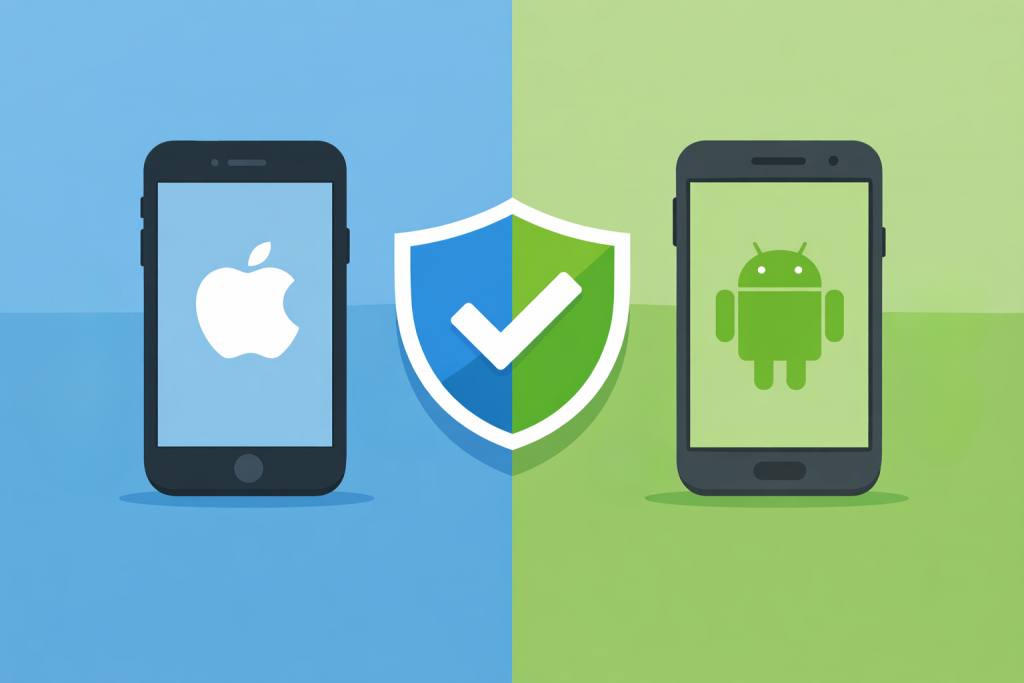
Previously, discussions about smartphone security boiled down to a simple dichotomy: Apple’s closed ecosystem versus Google’s open architecture. The iPhone was seen as a fortress, while Android was treated as a проходной двор, where behind every free widget a trojan could be hiding. But the industry has outgrown these generalizations. Today, the line between “secure” and “flexible” has blurred, and threats have become so specific that the type of operating system is no longer a guarantee of peace of mind.
From viruses to hunting vulnerabilities
At the dawn of mobile OS, protection relied on controlling sources. Apple bet on pre-moderation in the App Store and software isolation, effectively removing the user’s chance to make a mistake, but also limiting their choice of tools. Google chose a more democratic path: want to install apps from a memory card or third-party websites – go ahead. This shaped the first wave of threats – primitive malware that required active user involvement: press “install”, grant permission, open a file.
Over time, attackers shifted focus. Instead of convincing a person to download a virus, they began looking for technical flaws in browser code or system libraries. These are so-called vulnerabilities – “cracks” in the OS foundation that allow protection to be bypassed unnoticed. Modern systems have learned to confine apps in “sandboxes” so they cannot see each other’s data, but a compromise at the kernel level nullifies these efforts.
When closed doors fail to hold
The myth of iOS invulnerability was ultimately dispelled by complex targeted attacks. A notable case was recorded by cybersecurity researchers in Ukraine. It concerned a campaign attributed to the Russian group UNC6353. The scheme stood out for its simplicity: the user only had to visit a specific web resource. No confirmations or downloads – the script executed automatically through a browser breach.
The key tool here was DarkSword. This is not a classic virus that “lives” in the phone’s memory for months. Its strategy is blitzkrieg. Within minutes, the tool extracts passwords, conversations in Telegram and WhatsApp, SMS, and photos, then erases its traces. Rapid data extraction makes such an attack almost invisible to standard monitoring tools. Some DarkSword modules even “looked into” crypto wallets, which only confirms: modern hackers are interested in fast monetization or instant espionage, not long-term control over the device.
A new reality: chains and exploits
What was once available only to state intelligence agencies due to the extremely high development cost is now entering mass circulation. Attacks are becoming combined. Not a single flaw is used, but an entire chain of vulnerabilities: the first grants access to the browser, the second allows escape from the “sandbox”, the third provides administrative privileges.
Today, iOS and Android are converging in their defensive approaches. Both systems implement hardware encryption and strict control over access to the microphone or geolocation. Yet code complexity continues to grow, and with it, new errors are inevitable. The difference between platforms now lies not in the concept of “closedness”, but in how quickly the developer releases patches and whether they reach a specific device.
What matters for practical protection
The choice of smartphone brand now matters less than usage hygiene. If earlier it was enough to simply “avoid bad websites”, today a threat can come through a vulnerability in a system component that no one even knows about yet.
Even basic traffic encryption via an SSL certificate, which has become standard for most resources, protects only the data transmission channel. It prevents attackers from “listening” to your Wi-Fi in a café, but does not help if malicious code has already executed inside the device itself. When an attack like DarkSword gains access to memory, it sees information before the system manages to encrypt it for transmission.
The only real barrier is response speed. System updates are not about new icons or menu colors. They are primarily about closing those very breaches through which such tools operate. The longer a device remains without an up-to-date patch, the wider the window of opportunity for compromise becomes, regardless of whether there is an apple or a robot logo on the back panel.