
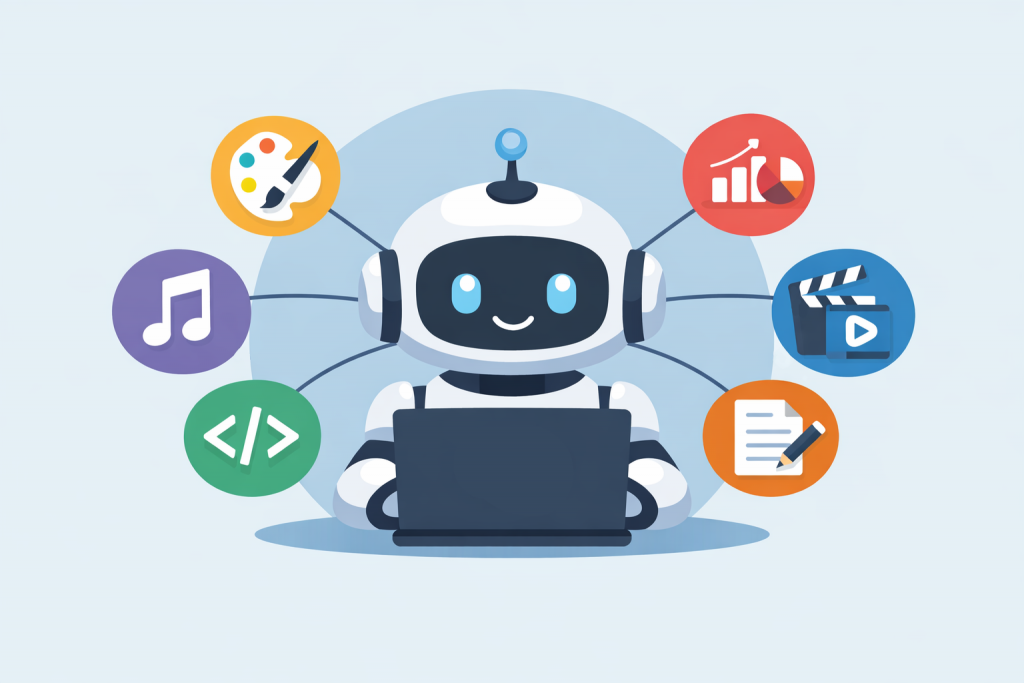
Just a few years ago, the digital lives of most people consisted of dozens of separate applications. Asana or Monday were used for task planning, GitLab for working with code, Wix for building websites, Duolingo for online learning, and specialized support platforms for working with clients. Each program performed a narrow function, and this was considered a normal model of computer use. Today, this logic is gradually changing. Artificial intelligence is taking over more and more tasks that previously required separate programs, and it does so within a single universal environment.
What the Latest Market Statistics Show
At the beginning of 2025, an infographic appeared listing fifteen companies from the SaaS segment whose shares showed the largest decline since the start of the year. SaaS stands for Software as a Service, meaning software that is used via the internet on a subscription basis without being installed on a computer.
Well-known brands appeared on this list, including Asana, GitLab, Atlassian, Bill, Tenable, HubSpot, Duolingo, Five9, Wix, Rapid7, and others. In some cases, the decline in share value exceeded 50–60 percent. This does not mean that these companies have gone bankrupt or lost their users. However, this trend clearly shows that investors have begun to doubt whether traditional online applications will be able to continue growing as quickly as they did before.
What Is Meant by “Familiar Software”
When people say that artificial intelligence is replacing familiar software, they are not referring to all computer systems in general, but to a specific type of product. These are standalone online services designed to perform one or several clearly defined tasks. For example, a service solely for task management, only for website creation, or only for language learning.
Such programs usually have their own interfaces, their own rules of operation, and require users to spend time learning how to use them. In the past, this was justified because there were simply no alternatives.
How User Behavior Is Changing
Artificial intelligence offers a fundamentally different approach. Instead of opening multiple applications and manually performing actions, users formulate a request in natural language. The system analyzes the context, suggests solutions, generates text, summarizes data, or helps make decisions on its own.
As a result, some of the functions for which people previously used Asana, Duolingo, or other specialized services are now performed directly within AI platforms. For users, this feels simpler and faster, as the need to switch between different interfaces disappears.
Why Universal AI Systems Look More Attractive
The main advantage of artificial intelligence lies in its universality. It is not tied to a single task. The same system can help with learning, information analysis, work planning, content creation, or report preparation. For users, this means fewer programs, fewer subscriptions, and less time spent on technical details.
This is precisely what gradually reduces the value of narrowly specialized software. Such programs do not disappear instantly, but they cease to be the only way to solve tasks and therefore lose some of their appeal to the market.
How Artificial Intelligence Is Changing Server Infrastructure
These processes are happening not only at the software level but also at the level of the technical foundation on which it runs. Artificial intelligence requires significantly more computing resources than traditional online services. Random access memory plays a particularly important role, as modern AI models actively work with large volumes of data in real time.
That is why large data centers are now actively purchasing servers with large amounts of RAM. This is not about isolated upgrades, but about large-scale investments in infrastructure optimized for artificial intelligence workloads. This is another signal that AI is no longer an experiment and is becoming a core technology around which the entire digital ecosystem is being reshaped.
What This Means in Practice
The decline in the share prices of companies such as Asana, Wix, or Duolingo does not mean the end of software as such. It indicates a shift in how people interact with technology. Instead of a collection of separate tools, users are gradually moving toward universal systems that deliver results without complex configurations.
Artificial intelligence does not eliminate familiar software overnight, but it gradually changes its role. Some products will become auxiliary components of larger AI platforms, while others will lose relevance. This transitional moment is exactly what we are witnessing today — and the market has already begun to respond to it not with words, but with numbers.
Leave a Reply
You must be logged in to post a comment.