
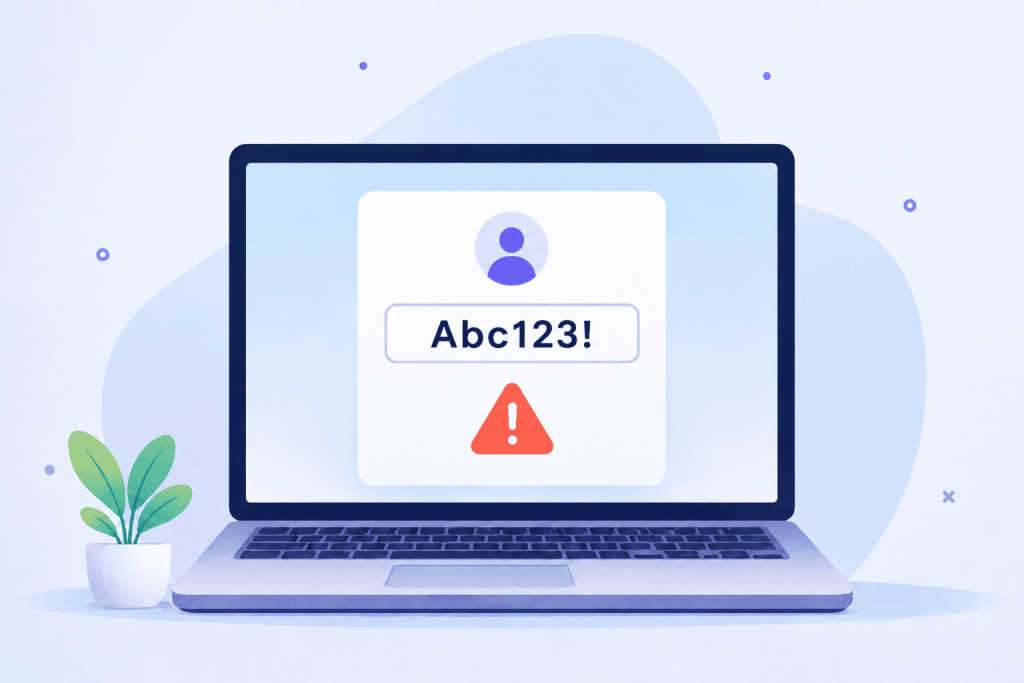
Passwords are often perceived as a formality: added a digit, put an exclamation mark – and the job is done. But this approach is based on rules from ten years ago, when there were far fewer services, and computing power for attacks was much more modest. Today each of us has dozens of accounts: from email and banks to work panels for domain management or cloud storage. A weak or repeated password in such an ecosystem creates a domino effect: once one site is hacked, everything is put at risk.
The main trap is that we are used to judging password complexity visually. A combination like P@ssw0rd1! seems reliable because it has both special characters and digits. In reality, it is built according to an obvious pattern, which automated guessing systems calculate instantly. A long phrase made of random words will be much more resistant: it is easier for a person to remember, and almost impossible for a machine to brute-force.
Why “capital letter + digit” no longer protects you
Most services still require the mandatory set: an uppercase letter, a lowercase letter, a digit and a symbol. Users have learned to bypass this rule mechanically: they write a word with a capital letter, then add the current year and an exclamation mark at the end. Summer2025! is formally perfect, but its logic is too typical.
Modern standards, in particular NIST recommendations, shift the focus from artificial “complexity” to length and uniqueness. There is no longer any point in forcing people to change passwords on schedule every 90 days. This only encourages them to create predictable sequences like Password1, Password2, and so on. A password should be changed only when there is a real threat of compromise.
Length as the main factor of resilience
The brute force method works simply: the system tries all possible options until it guesses the right one. The shorter the password, the faster the finish. Even if you use the entire available character set, the number of characters will be decisive.
| Password length | Digits only | Lowercase letters | Uppercase and lowercase letters | Digits, letters and symbols |
|---|---|---|---|---|
| 8 characters | instantly | about 1 hour | about 2 weeks | about 5 months |
| 10 characters | instantly | about 1 month | about 112 years | about 2 thousand years |
| 12 characters | about 7 hours | about 74 years | about 303 thousand years | about 10 million years |
| 14 characters | about 4 weeks | about 50 thousand years | about 819 million years | about 52 billion years |
| 16 characters | about 8 years | about 33 million years | about 2 trillion years | about 257 trillion years |
The difference between 8 and 12 characters is enormous. A short password, even with a chaotic set of symbols, can be cracked in a matter of days or months. Adding just a few characters turns the brute-force time into millions of years. This clearly proves why a long phrase always beats a short, even if confusing, code.
Which habits are worth giving up
- Changing a password “just in case”. As practice shows, this only leads to simpler combinations. Instead of coming up with something new, we simply change one character in the old pattern.
- Predictable letter substitutions. Using @ instead of a or 0 instead of o is the first thing algorithms check. If the password is based on a common word or a company name, such “masking” will not help.
- One password for all occasions. Even the most reliable combination becomes vulnerable if it is reused. A credential stuffing attack is based exactly on this: attackers take a stolen database from one site and automatically check those login-password pairs on other resources.
What really works today
Uniqueness is the foundation. Each critical account, especially email, should have its own key. Email is the front door to everything else, because it is used to reset passwords for banks, social networks and work accounts.
Another working tool is passphrases. This is not just one word, but a set of 4-5 unrelated words. They are easy to visualize in memory, but they create great length, which becomes a wall against brute force.
Two-factor authentication (2FA) is no longer an option “for the paranoid”. It is the norm. Even if your password ends up in a leaked database, the second factor in the form of an app code or push notification will stop the login. For financial and work services, this is a critical level of protection.
A practical approach to security
Instead of keeping dozens of complex combinations in your head, it is easier to delegate this to a password manager. It generates random long strings and fills them in where needed. You only have to remember one truly strong master password.
It is worth avoiding personal information that is easy to find online: children’s names, pet names, phone numbers or dates of birth. It is also useful to pay attention to browser notifications about leaks. If the system says that a password has been found in leaked databases – this is a signal for immediate action.
Modern security is not about a set of unclear symbols, but about not being predictable. A long phrase, a password manager and a second factor protect much better than any clever eight-character combination.