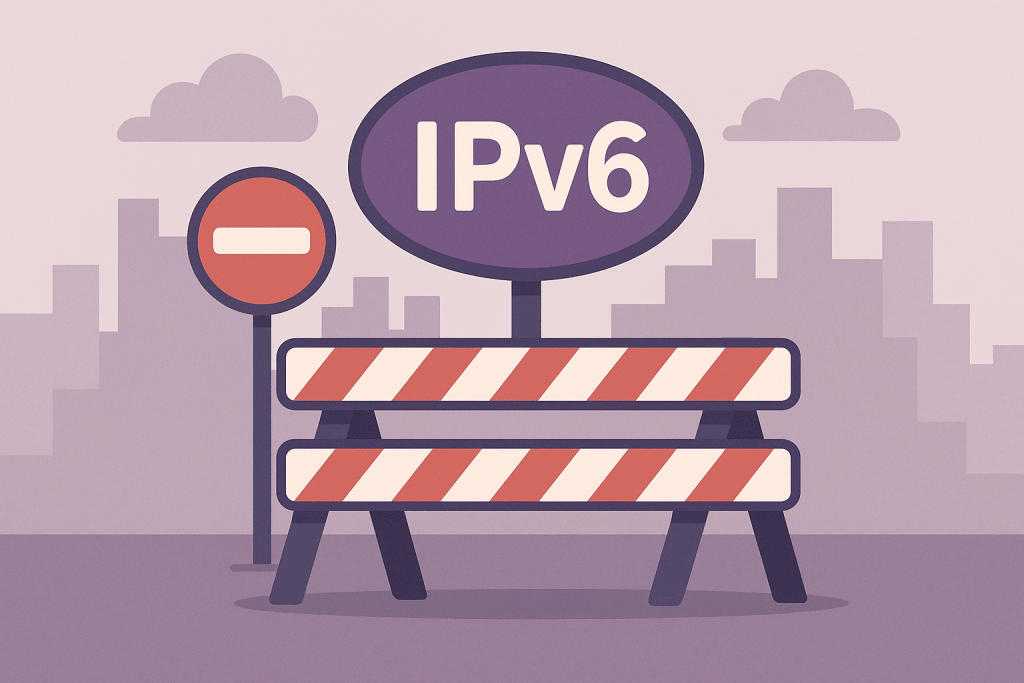
Despite the fact that the exhaustion of IPv4 addresses has been discussed for more than ten years, the transition to IPv6 still remains more of a prospect than a reality. In many countries, the use of the new protocol barely exceeds 30–40%, and some providers do not plan to implement it anytime soon. This is surprising, since IPv6 offers an almost unlimited pool of addresses, better bandwidth, a more modern approach to routing, and built-in security mechanisms. Why, then, is the internet infrastructure not rushing to adopt the new standard, and what consequences does this create for the market?
The Problem of Legacy and Infrastructure Inertia
IPv4 has been used since the 1980s, and over the decades, a massive ecosystem has formed around it: providers, data centers, network equipment, software, standards, and corporate networks. Many services fully depend on IPv4 logic and are not ready to work with IPv6 without significant changes. In network engineering, this issue is known as legacy infrastructure — when old systems slow down the development of new technologies because rebuilding them is expensive, complicated, or risky. For major operators, the transition means upgrading routers, updating firmware, testing compatibility, and redesigning network architecture. These are investments whose payback is not always obvious.
Support Required at All Levels
IPv6 cannot be implemented partially. It requires updates across three segments: providers, data centers, and end users. If any of these components do not support the new protocol, IPv6 addressing becomes practically unusable. For example, if a provider assigns IPv6 to a client, but the server the client connects to operates only on IPv4, the request will still go through the old scheme. This creates dual-stack — a mode where a system uses both IPv4 and IPv6 simultaneously. It is a compromise that simplifies the transition but complicates the network and increases provider costs.
Economic Barriers and Reluctance to Invest
For many companies, the main criterion is business necessity. IPv6 does not bring direct profit, and customers rarely choose a provider based on the availability of IPv6. Small operators can work for years without IPv4 scarcity by using NAT — a technology that allows many devices to share a single external IP address. Although NAT introduces additional latency and complicates certain types of connections, most users do not notice it. Therefore, investments in IPv6 seem unnecessary until the market demands otherwise.
Technical Risks and the Human Factor
Network upgrades involve not only purchasing equipment but also training specialists. Engineers who have worked with IPv4 for 20 years do not always strive to learn new protocols. Companies fear that the transition might cause outages, and customers may not understand the reasons for the issues. Moreover, IPv6 uses a fundamentally different approach to addressing: longer addresses, automatic configuration, and a different way of interacting with routers. This requires not just an upgrade but a change in established processes.
How Delayed Adoption Affects Internet Development
The consequences of slow transition are felt in almost every segment:
First, the cost of IPv4 continues to increase. On the global market, IP addresses have essentially become a commodity whose price rises every year. For infrastructure companies, this means additional expenses that sometimes exceed the cost of the server itself.
Second, the development of new services slows down. IPv6 allows IoT devices to be created without limitations — each sensor, meter, camera, or microcontroller can have its own unique address. As long as IPv4 dominates, these systems are forced to work through NAT or tunneling, which complicates scaling.
Third, security decreases. IPv6 has built-in support for IPSec — a technology for encrypting traffic. IPv4 does not offer this at the base level. Although encryption is not automatic, the structure of IPv6 was designed with modern threats in mind.
Overall, the old protocol is becoming a bottleneck: the internet evolves faster than the engineering approaches that support it.
When IPv6 Will Become a Full-Fledged Standard
Experts agree that the moment when IPv6 completely replaces IPv4 will come gradually but inevitably. Major streaming platforms, mobile operators, and large hosting providers are already actively implementing IPv6. The more such players join, the faster the market will experience the advantages. For businesses, this will mean better scalability, higher access speeds, and lower IP resource costs. And the earlier companies begin migrating, the less painful the process will be.
If you want to deploy modern infrastructure with IPv6 support or test how your services work in a dual-stack environment, Server.UA offers dedicated servers with native IPv6 support. This allows you to move toward the future of the internet without painful transitions and the limitations of the old addressing system.
Leave a Reply
You must be logged in to post a comment.