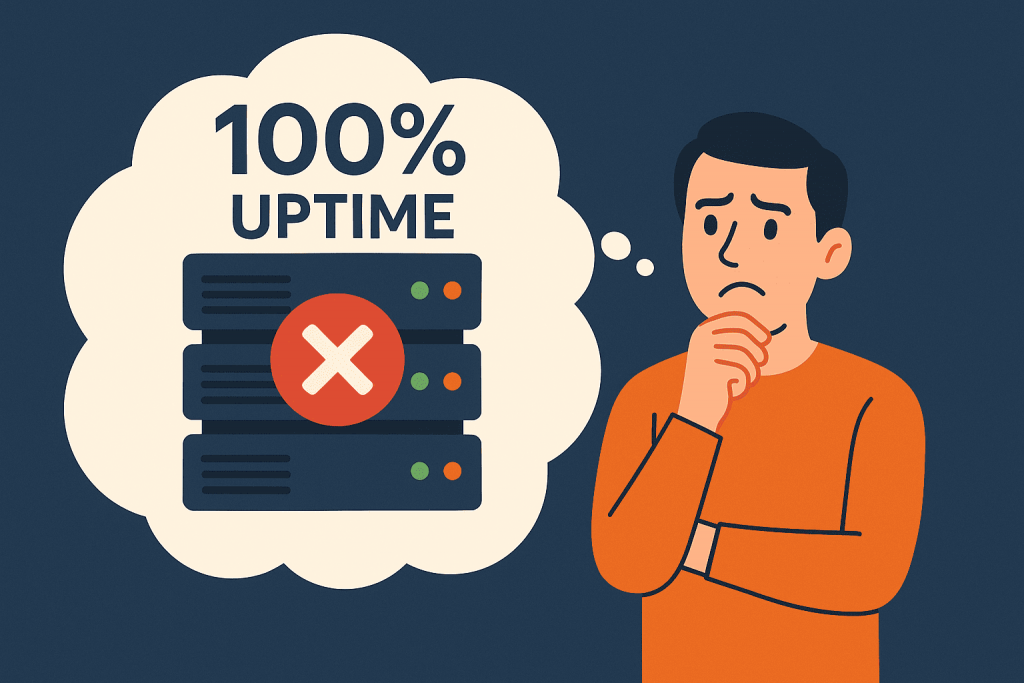
In today’s digital environment, every business wants to be sure that its website or application is always available. Users do not tolerate delays, and companies understand that even a few minutes of downtime can lead to financial losses, reduced trust, or indexing issues in search engines. That is why VPS and dedicated server services often highlight uptime — the percentage of time the infrastructure operates without interruption. However, in real engineering, an absolute 100% uptime is unattainable. Even if the servers are expensive, the data center is certified, and the network is fully redundant, physical and organizational limitations still exist. To understand why “fail-proof” hosting is more of a marketing term, it is important to examine how VPS and dedicated servers actually work.
Why 100% Uptime Is Impossible Even on the Most Powerful VPS and Dedicated Servers
Uptime refers to the period during which servers operate continuously. For VPS, this is the operation of a virtual machine running inside a physical server. If the physical host fails, all VPS instances on it go down as well, no matter how well they are configured. Dedicated servers have a different nature: the client receives the hardware entirely for their own use, but the risks of physical failures still remain. Any component — the processor, RAM, power supply, or SSD — can fail. Even systems with redundancy, such as dual power supplies or RAID arrays, cannot eliminate the risk entirely. Therefore, 100% uptime over a long period is impossible due to objective technical limitations inherent in hardware and infrastructure.
Planned Maintenance, Updates, and Unavoidable Interruptions
Another reason absolute continuity is unattainable is the need for ongoing maintenance and updates. Servers require regular kernel updates, security patches, hypervisor fixes, and network configuration optimizations — all of which may require reboots. With dedicated servers, clients can perform maintenance themselves, but even then small interruptions are inevitable. With VPS, maintenance on the physical node affects all customers on that host. If the data center upgrades network equipment, replaces a switch, or improves its cooling system, short downtimes may occur. These interruptions are planned in advance and usually last only minutes, but they still lower the uptime percentage and make 100% unattainable in practice.
Human Factor and the Complexity of Modern Infrastructure
Despite significant automation, many hosting operations still depend on people. Engineers, administrators, and data-center technicians perform a huge amount of manual work. Misapplied configurations, script errors, or inaccurate routing changes can all result in failures. In complex systems with dozens of hypervisors, hundreds of servers, and thousands of virtual machines, even a small mistake can scale into short-term unavailability. It is important to note that even global companies like Amazon Web Services, Google Cloud, and Azure experience incidents where parts of their data centers become unavailable for minutes or hours. If billion-dollar corporations cannot guarantee 100%, no other provider can either.
External Factors and Force Majeure Beyond Hosting Control
There are events no hosting provider can fully prevent. Global outages at internet providers can disrupt routing across entire regions. Power grid failures or issues with energy suppliers can affect data-center operations, especially during peak loads. Large-scale DDoS attacks can make infrastructure temporarily inaccessible even if protection systems work correctly. Fires, floods, military actions, earthquake vibrations, or issues with external backbone networks — these are factors that cannot be neutralized completely. Therefore, truly fail-proof hosting does not exist by definition: the outside world can overpower even the best technology.
How Hosting Providers Get as Close as Possible to Maximum Uptime
Although 100% uptime is unattainable, modern technologies make it possible to minimize downtime dramatically. Reliable providers use physical servers with redundant power supplies, NVMe drives in RAID arrays, multiple uplinks, and network-level redundancy. In VPS environments, hypervisors support live migration — the ability to move a virtual machine to another physical server without stopping it if maintenance is required. Dedicated servers offer IPMI and other remote management systems to respond to issues without physically visiting the data center. Modern data centers also use multi-layer power systems, advanced cooling, 24/7 monitoring, and automated recovery mechanisms. Combined, these measures allow uptime levels of 99.9–99.99%, which is considered extremely stable.
What Businesses Should Understand About Realistic Expectations
Website and service owners should understand that a VPS or dedicated server is not a magical box that works perfectly at all times. It is a complex engineering system dependent on hardware, network infrastructure, data-center performance, and human involvement. Even if a provider claims 99.99% uptime, that still means up to 52 minutes of downtime per year. This is very little — but not zero. Businesses should plan for scenarios where short periods of unavailability are not critical: use backups, configure DNS correctly, establish recovery procedures, and consider standby servers or geo-replication where appropriate. Understanding the realistic capabilities of infrastructure reduces risks and helps build operations without illusions.
In conclusion, “fail-proof” hosting is a beautiful concept without technical implementation. However, a well-designed VPS or dedicated infrastructure can deliver stability very close to the maximum possible if a reliable data center, thoughtful architecture, modern hardware, and reasonable expectations from the business are combined. This is a realistic, engineering-driven approach that does not promise the impossible but provides dependable results you can rely on.
Leave a Reply
You must be logged in to post a comment.