
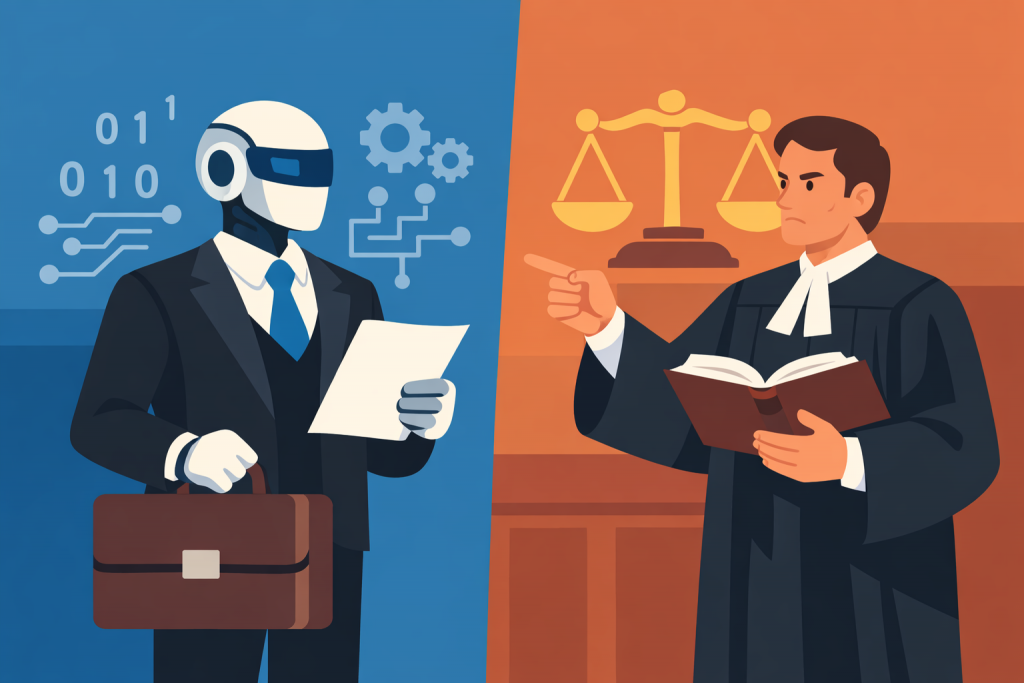
Just a few years ago, automation was primarily associated with factories, assembly lines, and physical labor. It was believed that intellectual professions related to analysis, writing, law, or management would remain an area of human advantage. However, the rapid development of artificial intelligence has changed this logic. Today, it is precisely the segment of the labor market that was long considered the most protected that has come under pressure — work based on knowledge, experience, and information processing.
Recent cases involving the use of AI increasingly demonstrate that machines are capable of performing complex intellectual tasks faster, more consistently, and at a lower cost than humans. These are not hypothetical forecasts, but practical experiments that are already shaping perceptions of the future of professions.
Artificial Intelligence as a Factor Changing the Balance in the Labor Market
The key difference of the current technological shift lies in the fact that automation has affected not routine actions, but cognitive processes. Artificial intelligence has learned to work with large volumes of text, analyze context, find logical connections, formulate arguments, and structure complex documents. What previously required many years of education and practice can now be performed by an algorithm in a matter of seconds.
A telling example comes from the legal field, where lawyers in the United Kingdom provided AI with a complex court case and asked it to prepare an appeal. The algorithm produced a full-fledged document in half a minute, and its quality turned out to be higher than that of the version an experienced lawyer had worked on for several days. This case became not a sensation, but a logical consequence of the development of technologies that have long been used for research, text verification, and drafting documents.
Why “Prestigious” Professions Are Under Threat
Lawyers, analysts, financiers, consultants, editors, and other specialists whose work is related to information processing have found themselves in the risk zone not by chance. These professions are based on repetitive intellectual operations: searching for data, comparing precedents, formulating standard documents, checking logic and compliance with rules. For humans, this is complex and time-consuming work, whereas for an algorithm it is an ideal environment.
An additional factor is economics. The cost of using AI decreases every year, while the risk of errors is gradually offset by speed, scalability, and the ability to verify results. In many companies, the decision in favor of automation is made not because technologies are perfect, but because they are practically expedient. As a result, a significant portion of functions that were previously performed by people gradually lose their economic rationale.
Education and Career in the New Reality
The technological shift is changing not only the labor market, but also the approach to education. A diploma that until recently was considered a guarantee of a stable career no longer provides protection against change. Educational programs often fail to adapt to the pace of technological development, and professional skills become obsolete quickly.
This does not mean that human labor is becoming unnecessary. Rather, it is about a change in the role of the specialist. Instead of performing routine intellectual operations, the value of systems thinking, responsibility for decisions, understanding of business context, and the ability to work with the infrastructure on which digital services are based is increasing. Humans are gradually moving from executors to controllers, integrators, and strategists.
The Technological Foundation of Change and the Role of Infrastructure
Artificial intelligence does not exist in a vacuum. Its effectiveness directly depends on reliable server infrastructure, computing resources, stable access to data, and uninterrupted operation of digital systems. That is why the technological shift in the labor market is closely linked to the development of data centers, cloud platforms, and server solutions.
Companies that implement automation are increasingly investing not only in algorithms, but also in the underlying infrastructure that ensures their operation. In this context, reliable server platforms become particularly important, as they make it possible to scale services, experiment with new technologies, and maintain control over data.
Leave a Reply
You must be logged in to post a comment.