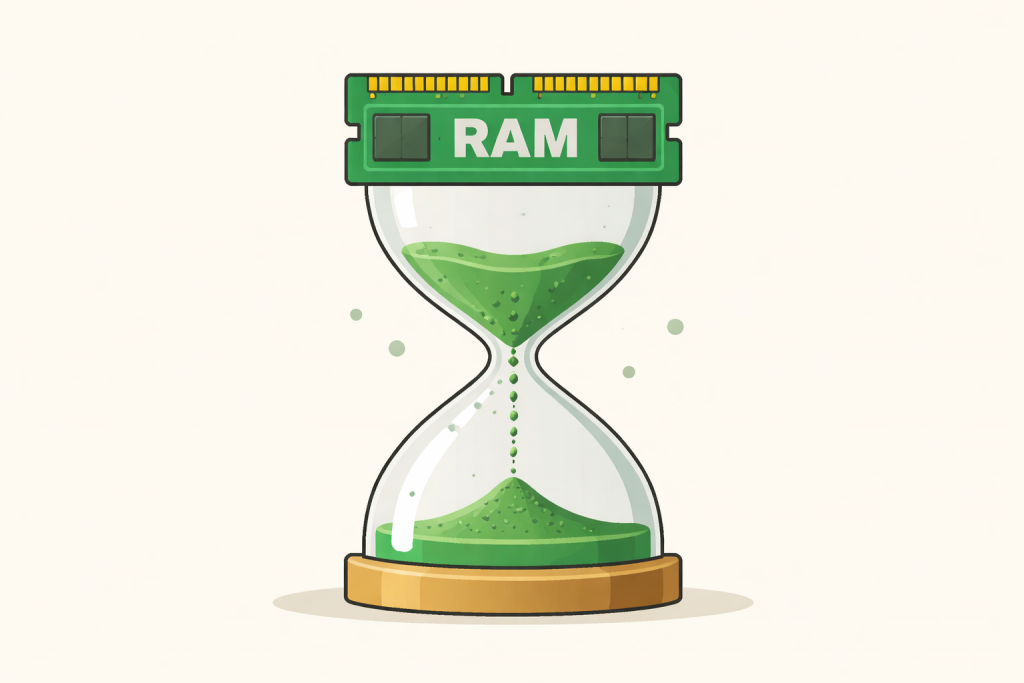
For many years, RAM remained a relatively affordable and predictable component of computer technology. Performance growth was accompanied by declining costs, and increasing the amount of RAM was considered a simple way to scale almost any project. However, today this model is rapidly collapsing. The world is entering an era in which RAM becomes a scarce resource, and its price and availability are determined by global infrastructure projects.
What RAM is and why the modern internet cannot work without it
Random access memory, or RAM, is fast memory that stores data actively used by the system. Web servers, databases, caching systems, cloud services, and any online platforms constantly rely on RAM. The more complex a service is and the greater the number of simultaneous users, the more RAM is required for stable operation.
For server infrastructure, RAM is a critical resource. Dedicated servers and VPS without sufficient amounts of RAM quickly hit performance limits, regardless of processor power or disk speed.
The Stargate project and a new scale of memory consumption
A turning point for the market has been the emergence of megaprojects in the field of artificial intelligence. One of the most striking examples is the Stargate project, developed by OpenAI together with its partners. It involves building a massive network of AI data centers around the world, designed for training and running complex artificial intelligence models.
According to analysts, Stargate could consume up to 40 percent of the world’s production of DRAM. To achieve this, OpenAI has entered into preliminary agreements with key memory manufacturers — Samsung and SK hynix. The supply volumes are impressive: about 900 thousand DRAM wafers per month. This amount is sufficient to produce approximately 200 to 500 million standard RAM modules every month.
Why this is an unprecedented situation for the market
A DRAM wafer is a silicon base from which memory chips are manufactured. When a single company or project reserves hundreds of thousands of such wafers every month, it effectively means a redistribution of global manufacturing capacity. In the case of Stargate, this involves almost half of the world’s DRAM production, something that was previously unthinkable for a single direction.
It is also important that these agreements do not have a clearly defined end date. They extend at least through 2029, with a potential continuation into the 2030s. This means that the shortage of RAM is no longer a temporary phenomenon and is turning into a long-term reality.
How AI data centers affect servers and VPS
When a significant portion of RAM is allocated to AI data centers, the rest of the market inevitably feels the impact. Server hardware manufacturers face supply constraints, and the cost of configurations with large amounts of RAM increases. This directly affects the dedicated server and VPS segment, where RAM is one of the key parameters.
For businesses, this means rethinking infrastructure approaches. Servers are no longer purchased “with a margin,” and every gigabyte of memory begins to carry economic significance. Even projects not related to artificial intelligence are forced to optimize resource usage in order to remain competitive.
Why cheap RAM may disappear forever
Experts agree that with such a balance of supply and demand, a return to the era of cheap RAM is unlikely. Building new memory manufacturing facilities requires years and billions of dollars in investment, while demand from AI continues to grow. Artificial intelligence is being integrated into search, medicine, finance, business analytics, and automation, and each new stage of development requires even more RAM.
As a result, RAM is gradually moving into the category of strategic resources, similar to electricity or network bandwidth. The world is entering a new reality in which RAM is no longer a cheap and abundant component, but becomes a foundation of the digital economy.
A new era of server infrastructure
The era of RAM shortages is changing the approach to developing online projects. Data centers, hosting providers, and service owners are forced to focus on efficiency, optimization, and precise planning. Dedicated servers and VPS remain the foundation of stable operation, but now under conditions of stricter resource control.
Understanding how megaprojects like Stargate are reshaping the global market makes it possible to better prepare for a future in which every gigabyte of RAM has strategic importance.
Leave a Reply
You must be logged in to post a comment.