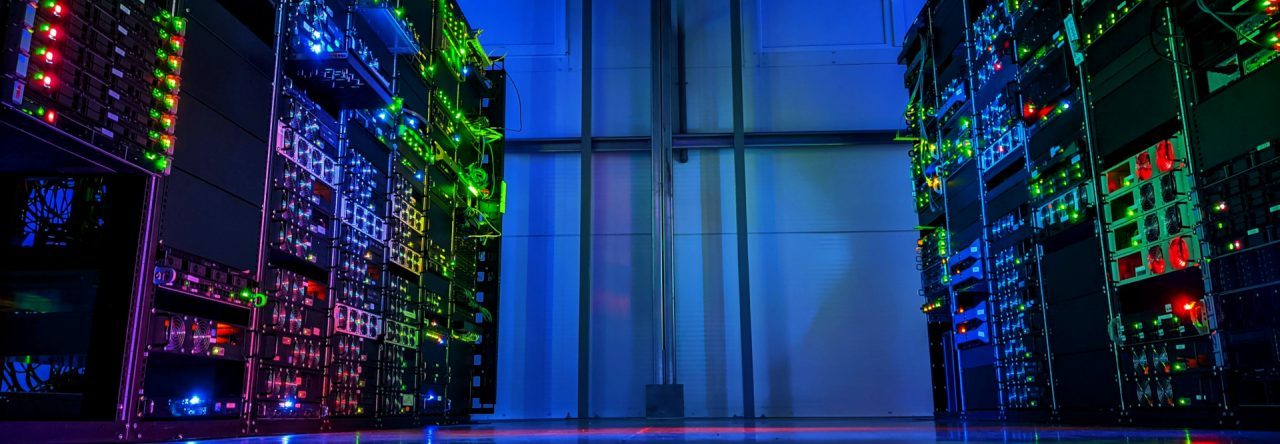
For most people, a data center is associated with something abstract: “servers are somewhere there, and they just work.” But those who have entered a real data center at least once almost always notice the same thing — a constant, steady, and fairly loud noise. It does not resemble the sound of an office air conditioner or a household fan. It is a background hum that does not disappear day or night and has very practical reasons.
Servers as a Source of Continuous Sound
The main source of noise in a data center is the servers themselves. A server is a specialized computer that continuously processes requests, stores data, runs websites, services, and applications. Unlike a home PC, servers operate around the clock and under constant load. Each one contains several powerful fans that cool processors, memory, and storage devices. The higher the server’s performance, the more heat it generates and the more intensively its cooling system must work.
Why Such Strong Airflow Is Necessary
Electronic components are very sensitive to overheating. If the temperature exceeds acceptable limits, equipment can become unstable or fail completely. That is why servers are cooled more aggressively than ordinary computers. Their fans are smaller but rotate at very high speeds, creating a characteristic high-frequency noise. When hundreds or thousands of such servers are placed in one hall, their sound merges into a continuous hum.
The Role of Air Conditioning Systems
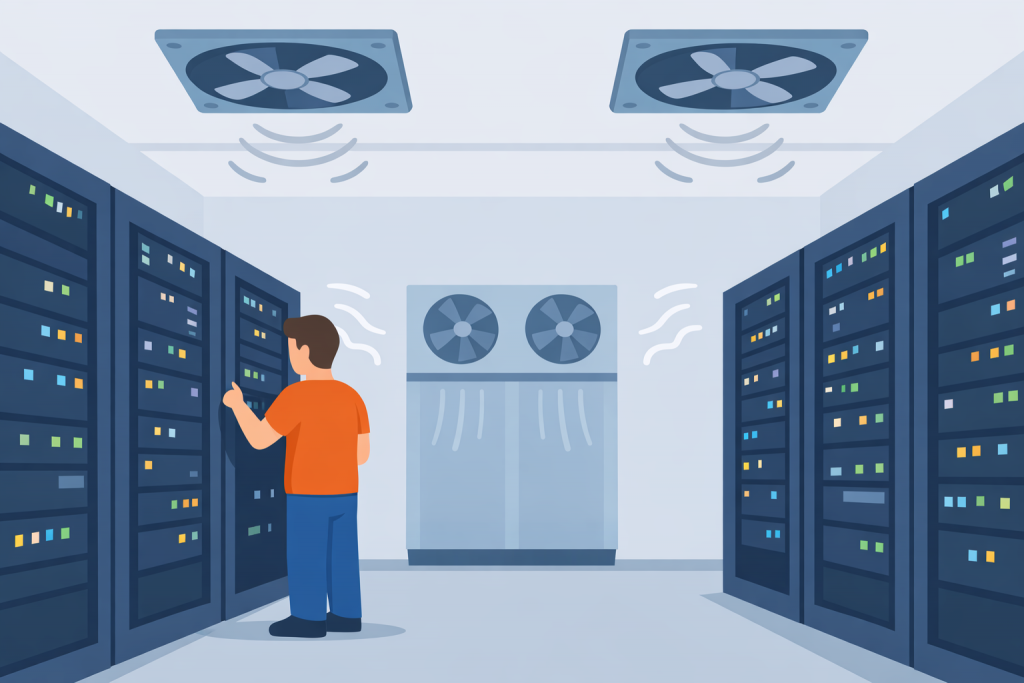
In addition to the fans inside the servers, industrial air conditioning systems operate throughout the data center. Their task is not just to cool the air, but to maintain stable temperature and humidity across the entire facility. These are complex engineering installations with powerful compressors, fans, and air ducts. They also operate continuously, because even a short-term rise in temperature can be critical for the equipment.
Airflow and Its Impact on Acoustics
Data centers are designed so that cold and hot air do not mix. For this purpose, so-called cold and hot aisles are used — zones where air moves in a predetermined direction. Airflows pass through server racks at high speed, which further amplifies the noise. Essentially, the entire data center hall becomes a controlled aerodynamic space where air is constantly in motion.
Backup Equipment That Also Makes Noise
Another reason for constant noise is backup systems. Data centers always have uninterruptible power supplies, diesel generators, additional fans, and auxiliary installations. Even if generators are not operating at full capacity, their cooling and control systems remain active. This is necessary so that in the event of an emergency, the data center can instantly switch to backup power without interrupting services.
Why Noise Is Not Fully Eliminated
It may seem that modern technology could make data centers quiet. In practice, however, silence is not a priority there. The main goals are stability, data security, and uninterrupted operation. Reducing noise would often mean lowering cooling efficiency or complicating the design, which increases risks. Therefore, engineers are more likely to choose a reliable and loud solution than a quiet but less predictable one.
Noise as a Sign of Living Infrastructure
Paradoxically, noise in a data center is a good sign. It means that servers are running, cooling systems are doing their job, and the infrastructure is in an active state. For specialists, the steady hum is a familiar background that indicates normal operation. Complete silence in such a place, on the contrary, could be an alarming signal.
What This Means for the User
For the average user, data center noise remains an invisible detail. They do not hear it when opening a website, sending an email, or using an online service. Yet this constant background is part of the complex technical ecosystem that ensures fast website performance, data availability, and the stability of digital services. Noise is a kind of price paid for the reliability and continuity of the modern internet.
Leave a Reply
You must be logged in to post a comment.