The global network today rests on glass and polyethylene. When we talk about the internet, we are not talking about the air, but about very concrete fiber-optic highways lying on the ocean floor. These threads pump enormous volumes of traffic – from banking transactions to datasets used to train neural networks. Optics wins because of physics: a light pulse inside the fiber provides the stability and speed that no wireless technology can yet deliver over long distances.
For engineers maintaining data centers, a cable is a clear variable. It can be laid, reserved, signal attenuation can be measured, and load can be predicted precisely. The entire segment of VPS hosting and cloud computing is essentially tied to this predictability. If a server is loaded, you know through which port and along which physical path the packet travels.
At the same time, operating cable lines, especially subsea ones, is always a risk and massive budgets. Every break caused by an anchor or an underwater shift turns into a logistical nightmare involving specialized cable-laying vessels. It is this vulnerability and cost that push the search for workarounds.
Abandoning wires in critical zones
Right now no one is trying to replace backbone cables between continents – that would be utopian. The search for alternatives goes where the wire becomes a burden. The most telling environment is one that used to be considered “deaf” to fast data transmission – great depths.
Traditionally, underwater work meant either a physical tether cable to a device, severely limiting maneuverability, or acoustic modems that transmit data at the speed of a carrier pigeon. In such conditions it is impossible to get real-time telemetry or to control processes on the seabed оперативно.
The Hydromea and Equinor case: optical Wi-Fi underwater
The breakthrough came from combining underwater robotics with “through-the-air” optics (free-space optics). The Swiss company Hydromea, in partnership with the Norwegian energy giant Equinor, tested a system that essentially creates a wireless network in the water column. Instead of pulling kilometers of cables to sensors on oil platforms or research stations, they used light-based modems.
The operating principle here differs from a conventional radio signal:
- Data is encoded into high-intensity light beams.
- Receivers on the seabed form network nodes, passing the signal from one to another.
- Speeds reach up to 10 Mbps – sufficient for streaming video from underwater drone cameras or collecting readings from pressure and temperature sensors.
For Equinor, this is not just about convenience, but about automation. Data from depths of several thousand meters is instantly delivered to the cloud for analysis. This eliminates delays that used to be measured in hours or even days (when data had to be stored on a physical medium inside the device).
A hybrid model as the new standard
What we see in the example of underwater optical modems is a precursor to the transformation of the entire network architecture. The cable is gradually losing its status as the only “last-mile” channel in complex conditions. In the future, infrastructure will become hybrid: backbone transmission will remain optical, but local nodes – whether oil fields, remote industrial facilities, or even parts of urban environments – will move to wireless solutions.
For the hosting and cloud services sector, this opens a path to processing data where it was previously impossible to collect it. Objects that used to be “offline” due to the inability to lay a cable become full-fledged points in the overall network.
Will a cable-free era arrive
There will be no complete abandonment of physical lines. Even the most advanced satellite constellations or optical systems in water have limitations in traffic density and latency over long distances. But the monopoly of the cable is over.
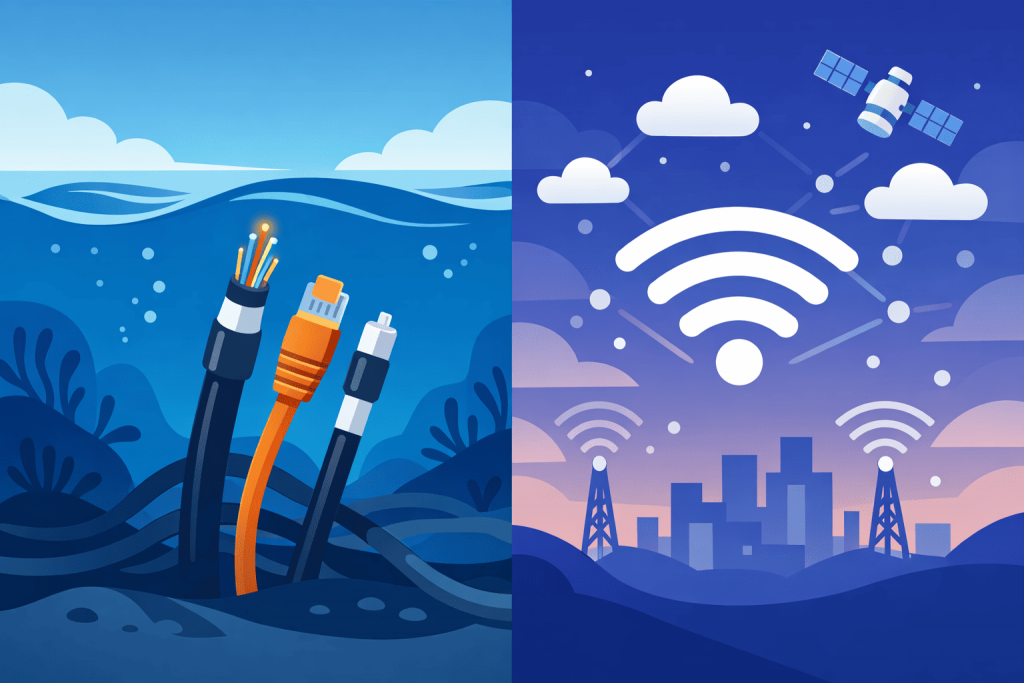
The internet is transforming into a multi-layered system. On the ocean floor, Hydromea modems operate; above the planet, satellite constellations are deployed; and between continents, thousands of tons of fiber still lie in place. These are not mutually exclusive things, but components of a single ecosystem where what matters is not the method of transmission, but the continuity of access to data.