In the coming years, the global computer hardware industry may face the most serious shortage of the past decade. The market for dynamic RAM (DRAM) and solid-state drives (SSD) is experiencing a sharp rise in prices and a shortage of components, affecting both electronics manufacturers and ordinary users. The reason behind this is the rapid shift of leading companies toward producing chips for artificial intelligence, which today consumes most of the world’s manufacturing capacity. To understand what this may lead to, it is worth examining the factors driving the new memory crisis.
Why the Demand for AI Chips Has Caused a Memory Shortage
Artificial intelligence is a set of technologies that allow computers to perform “intelligent” tasks, such as recognizing images, analyzing speech, or generating content. Processing such huge volumes of data requires specific types of memory. In addition to traditional DRAM, which we see in computers and laptops, the AI world actively uses HBM — High Bandwidth Memory, an ultra-fast memory with a very high throughput required by graphics processors and data centers.
Memory manufacturers such as Samsung and SK Hynix operate with limited capacity: there are few fabs, and building new plants requires billions in investment and years of waiting. When the demand for HBM skyrocketed, the companies shifted resources away from consumer memory production — standard DDR5 modules that are installed in PCs today. As a result, ordinary users found themselves in a situation where even basic components are rapidly increasing in price, and a shortage is forming that may last for years.
DRAM Prices Are Rising Faster Than Gold
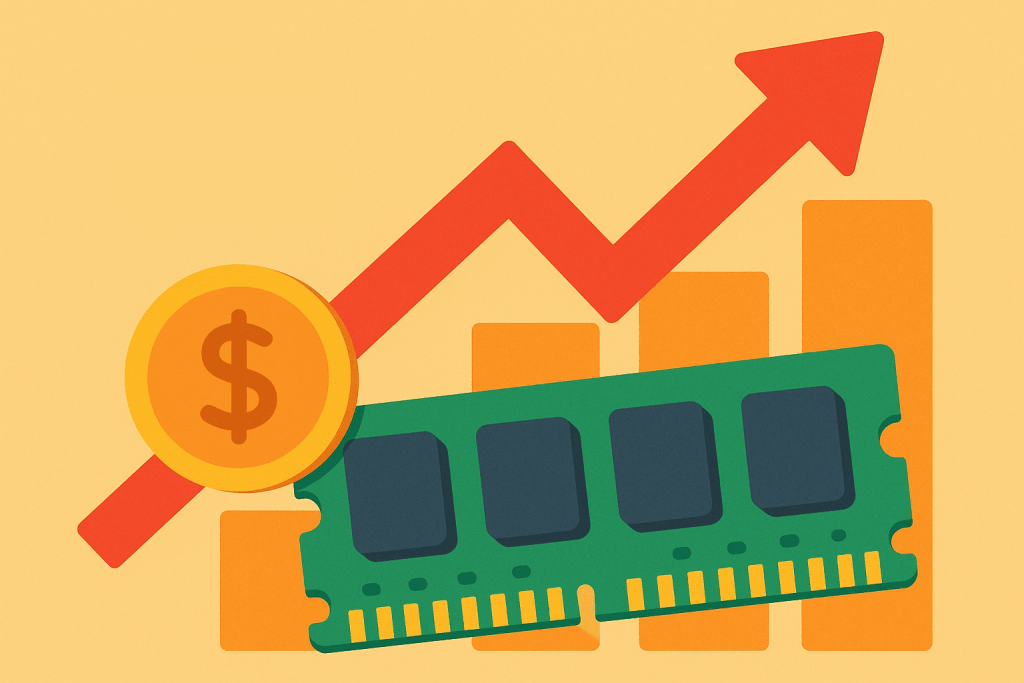
DRAM (Dynamic Random Access Memory) is the primary type of memory used in computers. Over the past year, DRAM prices have risen by more than 170%, and this is not the limit. By comparison, the rise in the cost of precious metals, including gold, looks much more modest. Items that previously cost a few dozen dollars are now priced similarly to a modern gaming console.
A 64 GB DDR5 kit has already exceeded the $500 mark — more than the cost of a PlayStation 5. This rapid rise is not tied to manufacturer greed, but rather to the shrinking amount of available memory on the market while demand continues to explode. Meanwhile, users who need PC upgrades face a dilemma: buy now at a high price or postpone the upgrade indefinitely.
The NAND and SSD Market Has Also Taken a Hit
In addition to RAM, the crisis has also affected another key segment — NAND memory, which SSDs are based on. One of the most notable signals came from Transcend, which announced a temporary halt in deliveries. Since October, the manufacturer has not received NAND chips from Samsung and SanDisk, as they too have switched production lines to AI components.
Without essential microchips, Transcend was forced to stop SSD production and shipments on November 7. This is not a short delay of a few days: according to the company’s forecast, the shortage may last 3–5 months, and the worst period is expected at the end of 2025 and the beginning of 2026. Even companies that still have stock warn that SSD prices will surge just as sharply as RAM prices in the coming months.
Who Will Be Affected by the New Global Memory Crisis
Although the changes began in the AI segment, the impact will be felt by absolutely everyone. Rising memory prices will affect both consumers and businesses. An ordinary buyer will discover that assembling a new PC or upgrading an old one now costs hundreds of dollars more. Laptop manufacturers will raise the prices of new models, and budget series may become even less accessible.
Businesses working with large amounts of data will feel the rising cost of server components. For data centers, memory is a fundamental resource without which infrastructure cannot scale. If companies are switching to cloud services or deploying AI solutions en masse, their hardware expenses will increase accordingly. This may lead to gradual global price increases for hosting, servers, and other IT services.
What Users Can Expect in the Coming Years
Analysts predict that the market will not stabilize for several years. During this time, manufacturers may build or modernize production lines, but this requires time and investment. Therefore, the coming years will be marked by heightened instability: prices may fluctuate sharply, and popular memory and SSD models may periodically disappear from stores.
Ordinary users should follow the situation closely and plan hardware upgrades in advance. Businesses should factor potential price increases into their budgets and pay attention to infrastructure optimization. In such conditions, choosing reliable providers who regularly update equipment and ensure stable services — even during global crises — becomes especially important.
How to Reduce Risks and Ensure Infrastructure Stability
The memory crisis is not just another price spike but a long-term structural process tied to a shift in the global priorities of the tech industry. The more companies move toward AI, the fewer resources remain for the consumer segment. But there is still a way forward: businesses can minimize risks by choosing providers that maintain their own server infrastructure, have sufficient capacity reserves, and update equipment gradually without shifting market pressure onto their clients.
Leave a Reply
You must be logged in to post a comment.