
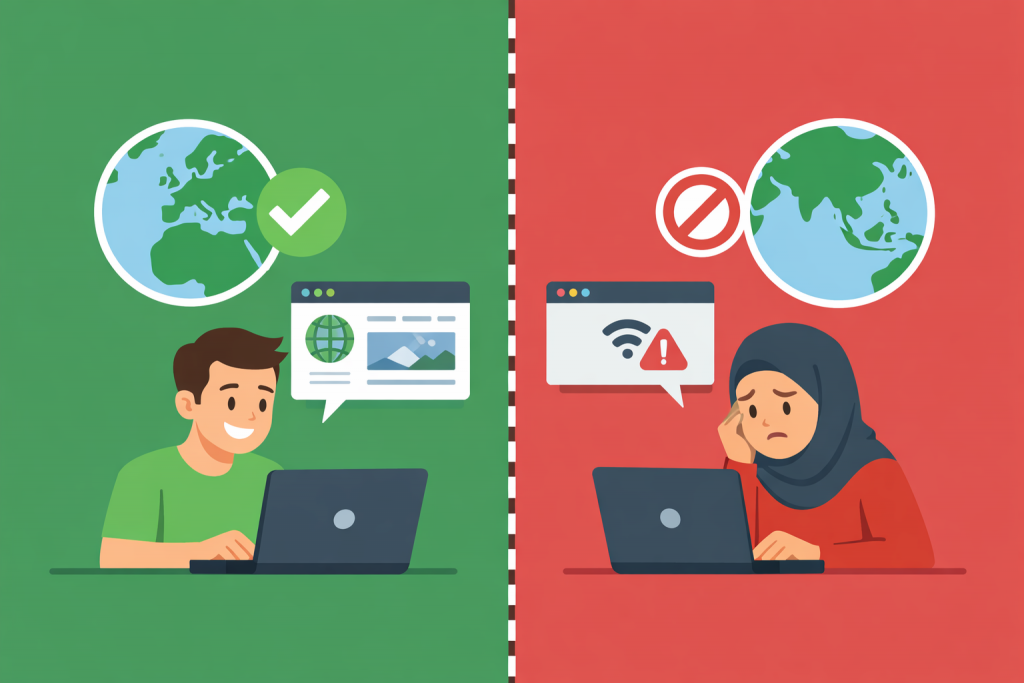
The internet is often perceived as a global space without borders, where any website is accessible from anywhere in the world. In practice, things work differently. A user may open a website without any issues from Ukraine, Poland, or Germany, but receive an error or no access at all from another country. For many people this seems strange or even alarming, although in most cases the reason lies not in the website itself, but in how internet infrastructure and servers are built and operated.
How a user’s country is determined
When a person opens a website, their request reaches the server from a specific IP address. An IP address is a unique numerical identifier assigned to a device on a network. Using this identifier, special databases can roughly determine the country, region, or even the city from which the connection is made. This mechanism is called IP-based geolocation. It is not perfect, but it is accurate enough for servers and network filters to understand where a request is coming from.
Geoblocking as an intentional access restriction
One of the most common reasons a website is unavailable from certain countries is intentional geoblocking. A website owner or server administrator may restrict access for specific regions. This is often done for security reasons, when a large number of attacks, hacking attempts, or spam originate from certain countries. In such cases, the server simply refuses to process requests from those IP ranges, and for the user the website appears to be “not working.”
The impact of hosting and server location
The physical and network location of a server also matters. Servers are hosted in data centers that are connected to the global network through various internet providers. If there are routing problems between the user’s country and the server, meaning issues with the path data takes across networks, the website may not open or may work unstably. In such situations, the website is accessible from some countries and unavailable from others not because of restrictions, but due to technical issues at the network level.
The role of CDN and global content delivery networks
Many modern websites use CDNs, or content delivery networks. Simply put, this is a system of servers located in different countries that store copies of a website. A user connects not to a single central server, but to the nearest one. If a CDN node in a particular region is malfunctioning or has limitations, the website may not open from that country, while users in other regions experience no problems.
Restrictions at the level of governments and providers
Sometimes the issue has nothing to do with the website owner or the server at all. In some countries, there are government-imposed restrictions on access to certain resources or entire categories of websites. Internet service providers may block traffic to specific addresses in order to comply with these requirements. For the user, this looks like an inaccessible website, even though the server itself is operating normally and accepting requests from other countries.
Security systems and automated filters
Websites running on servers with higher security requirements often use automated protection systems. These systems analyze request behavior and may mistakenly classify traffic from certain regions as suspicious. As a result, legitimate users are blocked even though they are not doing anything wrong. This is especially common when a website is hosted on a server with limited resources or aggressive security settings.
Why server infrastructure plays a decisive role
Stable access from different countries directly depends on the quality of servers, network channels, and hosting configurations. A server with reliable connectivity, proper routing, and well-designed security rules ensures that a website is accessible to a global audience. In contrast, weak infrastructure or excessive restrictions can make a website effectively “local,” even if it is technically available worldwide.
How this looks from the user’s perspective
For an average user, all these technical details are hidden. They simply see whether a website opens or not. However, behind this simple action lies a complex system of servers, networks, filters, and rules. Understanding that website accessibility can depend on the user’s country helps people react more calmly to such situations and avoid jumping to conclusions about a website being “broken.”
In summary, different website availability across countries is the result of a combination of geolocation, security policies, server operation, and global network infrastructure. Servers play a key role in whether a website can operate reliably and remain accessible to users in different parts of the world.
Leave a Reply
You must be logged in to post a comment.