
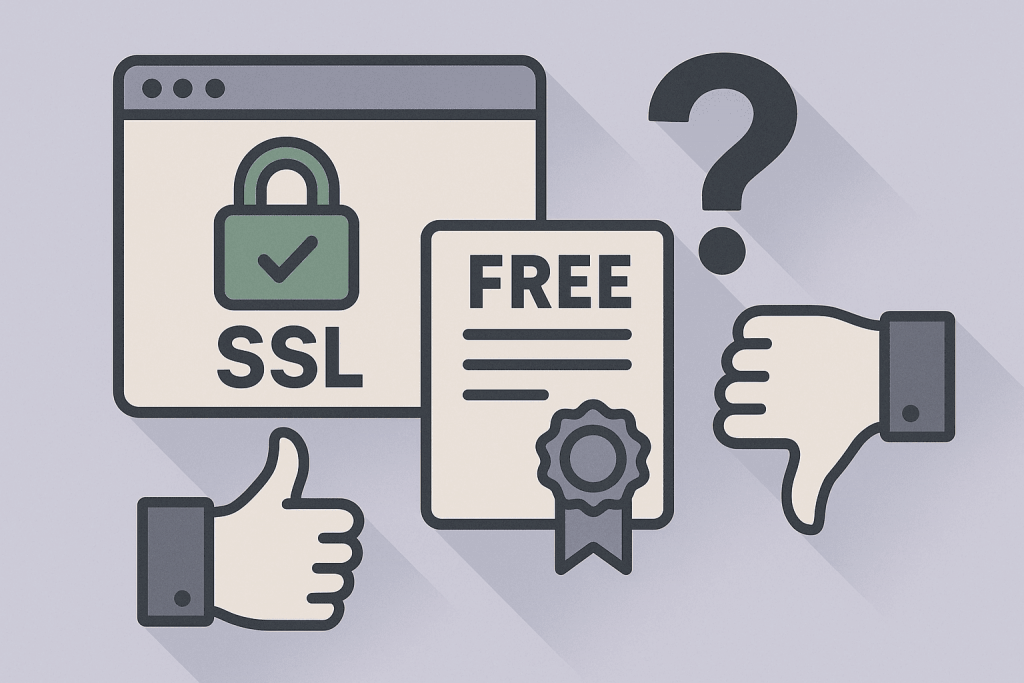
In today’s internet, users are accustomed to seeing the green padlock next to a website address and the letters https. For many, this symbol signals a safe resource where data is transmitted securely. However, an important question remains: can free SSL certificates — used by thousands of websites — be fully trusted? To answer this, it’s essential to understand how SSL works, how free certificates differ from paid ones, and what risks actually matter for businesses and users.
What SSL Is and Why It Matters
SSL (Secure Sockets Layer) is an encryption technology that creates a secure channel between a user’s browser and a server. When SSL is active, all transmitted data is encrypted so no third party can intercept or read it. Essentially, SSL is a “lock” between two communication points, ensuring that no one can interfere. The updated version of SSL is TLS (Transport Layer Security), but the term SSL remains widely used, so both are treated as interchangeable.
Without a certificate, information is transmitted through an unprotected channel — meaning passwords, emails, or payment details can be intercepted. This is why most providers and browsers today require SSL, and websites without https are marked as unsafe.
How Free SSL Certificates Emerged
For many years, SSL was a paid service available mostly to businesses. Everything changed with the launch of Let’s Encrypt — a nonprofit project that, in 2015, made SSL accessible to everyone. Let’s Encrypt uses an automated ACME protocol that verifies domain ownership and issues a certificate valid for 90 days. This led to a massive “democratization” of https: millions of websites adopted encryption at no cost.
Other services, such as ZeroSSL and Buypass Go, also offer free DV (Domain Validation) certificates. They follow the same principle: verify domain control and issue a short-term certificate.
How Free SSL Differs from Paid SSL
Although all SSL certificates use the same level of encryption, there are important differences between them. Free certificates are always DV certificates — they only confirm that the person requesting the certificate controls the domain. They do not verify the company, individual, or any legal details. A user sees https, but receives no confirmation about who exactly stands behind the website.
Paid certificates can be DV, OV, or EV. OV (Organization Validation) means the certificate authority manually verifies the company’s legal information, address, and contact details. EV (Extended Validation) offers the highest level of verification, confirming both the company and its right to use the specific domain. EV certificates are commonly used by banks, financial services, and large corporations.
Thus, the encryption is the same, but the level of trust is very different. A free SSL certificate encrypts data but does not prove that the website belongs to a legitimate organization.
Are Free SSL Certificates Safe for Regular Websites?
In most cases — yes. For blogs, portfolios, informational sites, and small projects, a free SSL certificate provides more than enough protection. Data is encrypted, and browsers display no warnings. This allows website owners to implement basic security quickly and without costs.
Let’s Encrypt and similar services have an excellent reputation, and all modern browsers fully trust their certificates. From a technical perspective, they are identical to paid DV certificates: same algorithms, same encryption strength, same protocols.
The Weak Points of Free Certificates
The main drawback of free certificates is their short validity period — typically 90 days. If automated renewal isn’t configured properly, a site can suddenly lose https. Browsers will immediately show a warning, potentially causing user loss or harming SEO if the problem persists.
Another weakness is the lack of identity verification. This is exactly why scammers often use free SSL for phishing pages — the site becomes encrypted, but that doesn’t make it trustworthy. Users see https and assume safety, even though the site may be designed to steal data.
For online stores, payment systems, banks, and large companies, free SSL is not suitable because it doesn’t confirm legal responsibility. OV and EV certificates provide an additional layer of trust and help customers verify who they are interacting with.
Which SSL Should Businesses Choose?
The choice depends on the website type and the level of trust it needs to build. If the site is informational and does not handle sensitive data, a free SSL certificate is a great solution — simple, fast, and fully compliant with security standards.
For services that manage payments, personal accounts, personal data, or legally significant information, OV or EV certificates are the better choice. They confirm the legitimacy of the organization and reassure users that they are dealing with a verified entity.
Paid certificates also often come with warranties from the issuing authority — financial compensation in case of a breach — something free certificates do not provide.
Can You Trust Free SSL Certificates
Yes — but with the right expectations. Free certificates deliver full encryption and protect data just as effectively as paid DV certificates. For many websites, especially content-based or personal projects, this is entirely sufficient.
However, they are not ideal for commercial platforms where legal verification and trust are critical. Paid certificates offer a higher level of credibility and additional guarantees.
Ultimately, the decision depends on your website’s purpose and the trust you want to establish with your users. Free SSL is an excellent starting point, but serious businesses should choose solutions that provide not only encryption, but also verified reliability and accountability.
Leave a Reply
You must be logged in to post a comment.