
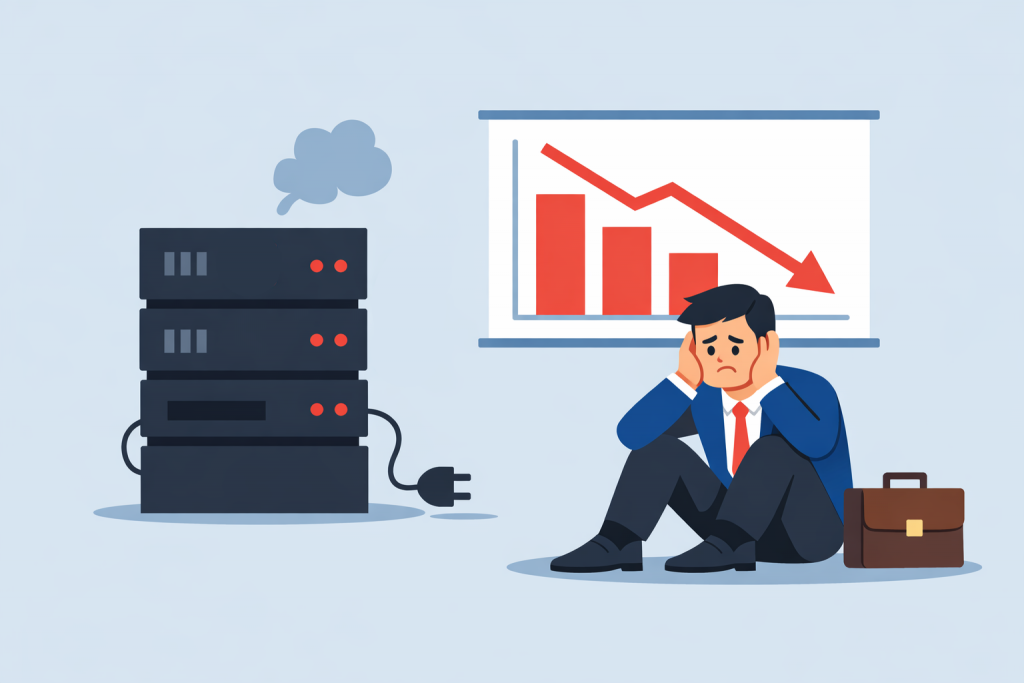
At the start of any project, the desire to save money seems logical. The business has not yet begun to generate stable income, the load is low, and the server appears to be just a technical background element that does not directly affect sales. That is why many companies choose the cheapest server solutions or minimal configurations “for now.” The problem is that a server is not a one-time purchase but the foundation of a digital business. Mistakes made at this stage rarely show up immediately, but they almost always become apparent when the project begins to grow.
A Server as the Foundation of Business Processes, Not Just Hardware
For a broad audience, a server often looks like an abstract concept — “some computer somewhere in a data center.” In reality, the server is the environment where the website runs, the CRM system operates, online payments are processed, customer accounts function, and internal company services work. Even short-term instability means lost inquiries, disruptions in staff workflows, or a negative user experience. When a business saves on its server, it is effectively agreeing to a compromise on stability, even if this is not obvious at first.
Cheap Infrastructure and Hidden Limitations
Most often, saving money means choosing minimal resources — a small amount of RAM, a weak processor, or a slow disk. RAM determines how many processes a server can handle simultaneously, the processor affects calculation speed, and the disk is responsible for reading and writing data. When these resources operate at their limits, the system starts to slow down. At first, this appears as slow page loading, but over time it turns into failures during peak loads, such as advertising campaigns or periods of seasonal demand.
The Impact of Server Issues on Customer Trust
For customers, technical details do not matter. They do not analyze why a website loads slowly or why a payment did not go through on the first attempt. They simply conclude that the service is unreliable. One such experience is often enough to lose a customer permanently. In this sense, saving on servers turns into a reputational risk that is difficult to measure in numbers but directly affects business growth.
Scaling That the Server Is Not Ready For
Scaling is the stage when a business starts to grow actively: more users, more transactions, more data. If the server infrastructure was not designed with this scenario in mind, the company faces the need for urgent migrations. Migration means moving a website or services to another server. For the business, this results in additional costs, the risk of downtime, and the need to operate in emergency mode. What seemed like savings at the beginning becomes a more expensive and complex task in the future.
Security as a Collateral Victim of Cost Cutting
A server is not only about speed but also about security. Outdated systems, the absence of backups, or minimal security settings are often the result of saving money. Backups are saved copies of data that allow a website to be restored in the event of a failure or an attack. When they are missing or unreliable, any incident can lead to data loss. For a business, this means not only financial damage but also legal and reputational consequences.
Short-Term Benefits Versus Long-Term Strategy
Saving on servers usually looks beneficial only in the short term. It reduces initial costs but ignores business development. A strategic approach involves choosing a server solution with a resource margin and the ability to scale flexibly. This does not mean overpaying for unnecessary capacity, but it does mean thinking ahead and viewing the server as an investment rather than an expense.
Why Server Solutions Should Be Part of the Strategy
A server is a quiet but critically important part of a business. When it works well, no one notices it. When it becomes a weak link, problems quickly surface and affect all processes. That is why saving on servers often becomes not just a technical mistake but a strategic one. It limits growth, undermines customer trust, and forces the business to react to problems instead of developing in a planned and sustainable way.
Leave a Reply
You must be logged in to post a comment.